Student delegateIn the room
How to write a MUN resolution (format, paragraphs and a full example)
In short
In this guide · 10 parts · 12 min
What is a draft resolution in MUN?
The formal text a committee debates and votes on: a heading, preambular paragraphs with the reasons, then numbered operative paragraphs with the actions.
A sample MUN resolution
Each line starts with its label: PP means a preambular paragraph, OP an operative paragraph. The UN prints each line's opening phrase in italics.
- DraftDraft resolution 1.1
- CommitteeGeneral Assembly
- TopicSafe drinking water in schools
- SponsorsGhana, Peru and Viet Nam
- SignatoriesCanada, Egypt, Fiji, Germany, India, Jordan, Mexico and Norway
- HeadingThe General Assembly,
- PP1Recalling its resolution 64/292 of 28 July 2010, which recognizes the right to safe and clean drinking water and sanitation as a human right,
- PP2Reaffirming its commitment to Sustainable Development Goal 6, to ensure availability and sustainable management of water and sanitation for all,
- PP3Deeply concerned that, in 2023, 447 million children had no basic drinking water service at their school,
- OP1Calls upon all Member States to build safe drinking water points in every public school by 2035, through their national school building programmes and funded from their education budgets;
- OP2Invites the United Nations Children's Fund and the World Health Organization, when Member States ask for support:
- OP2 (a)To help identify the schools that have no safe drinking water;
- OP2 (b)To train local staff to maintain water points and school toilets;
- OP3Requests the Secretary-General to report to the General Assembly at its next session on the implementation of the present resolution.
Practice sample
The header names who wrote it and who wants it debated. Every operative paragraph names who acts: all Member States, two UN bodies, then the Secretary-General. OP3 asks for a report at the next session, a common way to end a draft.
MUN resolution format
One long sentence: the body's name, unnumbered preambular paragraphs ending in commas, then numbered operative paragraphs ending in semicolons.
Italics, not underlining. The UN puts the opening phrase of every paragraph, and the name of the body, in italics. THIMUN-style conferences usually underline them, so follow your conference. Opening phrases from the lists below. A preambular paragraph often opens with a word ending in -ing, such as “Recalling”, or an adjective, such as “Deeply concerned”. When two paragraphs in a row share an opening phrase, add “also”, then “further”: “Recalling also” in the preamble, “Also requests” in the operative part. Commas in the preamble. Preambular paragraphs are not numbered, and each one ends with a comma. Numbers and semicolons in the operative part. Each operative paragraph opens with a present-tense verb, is numbered and ends with a semicolon. Subparagraphs. A colon introduces them, they are lettered (a), (b), (c), and in the operative part each ends with a semicolon. One full stop. Only the last operative paragraph ends with a full stop (a period). No abbreviations. Write each name in full the first time it appears in the preamble, and again in the operative part.
MUN resolution template
A blank resolution with every part you fill in shown in square brackets.
Each line starts with its label: PP means a preambular paragraph, OP an operative paragraph. The UN prints each line's opening phrase in italics.
- Committee[Name of your committee]
- Topic[The topic, as your conference names it]
- Sponsors[Countries that wrote the draft]
- Signatories[Countries that want it debated]
- HeadingThe [General Assembly],
- PP1[Recalling] [an earlier resolution or treaty on your topic],
- PP2[Deeply concerned] [about the problem, with one fact and its source],
- PP3[Recognizing] [what has already been done, and what is still missing],
- OP1[Calls upon] [who] to [do what] [how] [by when], [funded by whom];
- OP2[Requests] [who] to [do what]:
- OP2 (a)[First part of the action];
- OP2 (b)[Second part of the action];
- OP3[Urges] [who] to [do what] [by when].
Source: mymun template
Preambular paragraphs
Preambular paragraphs give the reasons for acting: the Charter and earlier resolutions first, then the facts of the problem.
Ten preambular phrases to start with
- Recalling
- Recognizing
- Reaffirming
- Noting
- Welcoming
- Taking note of
- Stressing
- Emphasizing
- Acknowledging
- Deeply concerned
Operative paragraphs
Operative paragraphs are the actions: each opens with a verb and asks for, decides or recommends one thing.
Ten operative verbs to start with
- Encourages
- Requests
- Calls upon
- Welcomes
- Recognizes
- Urges
- Reaffirms
- Takes note of
- Decides
- Invites
General Assembly vs Security Council
| Feature | General Assembly | Security Council |
|---|---|---|
How to write strong operative paragraphs
A strong operative paragraph names who acts, what they do, how, by when and who pays.
Who acts? Member States, a UN body or the Secretary-General. What do they do? One clear action. How? A fund, a programme or a law. By when? A date or a deadline. Who pays? Where the money comes from.
Weak: “Encourages countries to improve water in schools;”. It is vague about who acts, and it names no method, no date and no money. Strong: “Calls upon all Member States to build safe drinking water points in every public school by 2035, through their national school building programmes and funded from their education budgets;”. It answers all five questions.
Make this operative paragraph strong
Each line starts with its label: PP means a preambular paragraph, OP an operative paragraph. The UN prints each line's opening phrase in italics.
- OP1Encourages countries to do more about plastic waste;
Hint 1
Hint 2
Show the model answer
Each line starts with its label: PP means a preambular paragraph, OP an operative paragraph. The UN prints each line's opening phrase in italics.
- OP1Calls upon all Member States to phase out single-use plastic bags by 2030 through national laws, with a voluntary fund, managed by the United Nations Environment Programme, that helps developing countries pay for alternatives;
Check your answer
Writing the resolution with your bloc
Get your paragraphs into your bloc's draft, trade the rest in a merge, then sponsor the draft that carries them.
Can you write your resolution before the conference?
Your conference's procedure
Not sure? Check your conference's rules: caucuses point to North American, and lobbying and open debate point to THIMUN-style.
Bring ideas for two or three paragraphs in your notes, so you add wording, not only a signature. Offer them early, in the first unmoderated caucus, then listen to what the others need. Type the agreed paragraphs yourself into your bloc's working paper, because whoever types proposes every first wording. Keep the dais informed about your ideas and how your talks are going.
Working paper vs draft resolution
Working paper: your bloc's first written ideas, in any format. Draft resolution: the working paper rewritten in resolution format, with enough sponsors and signatories and the dais's approval. Resolution: the draft the committee adopts in a vote.
“Ghana can accept your operative paragraph 3 if our operative paragraph 1 stays in.”
Sponsors and signatories
“Two of these paragraphs are Ghana's. Can Ghana join as a sponsor?”
How to write your resolution in MUN Command
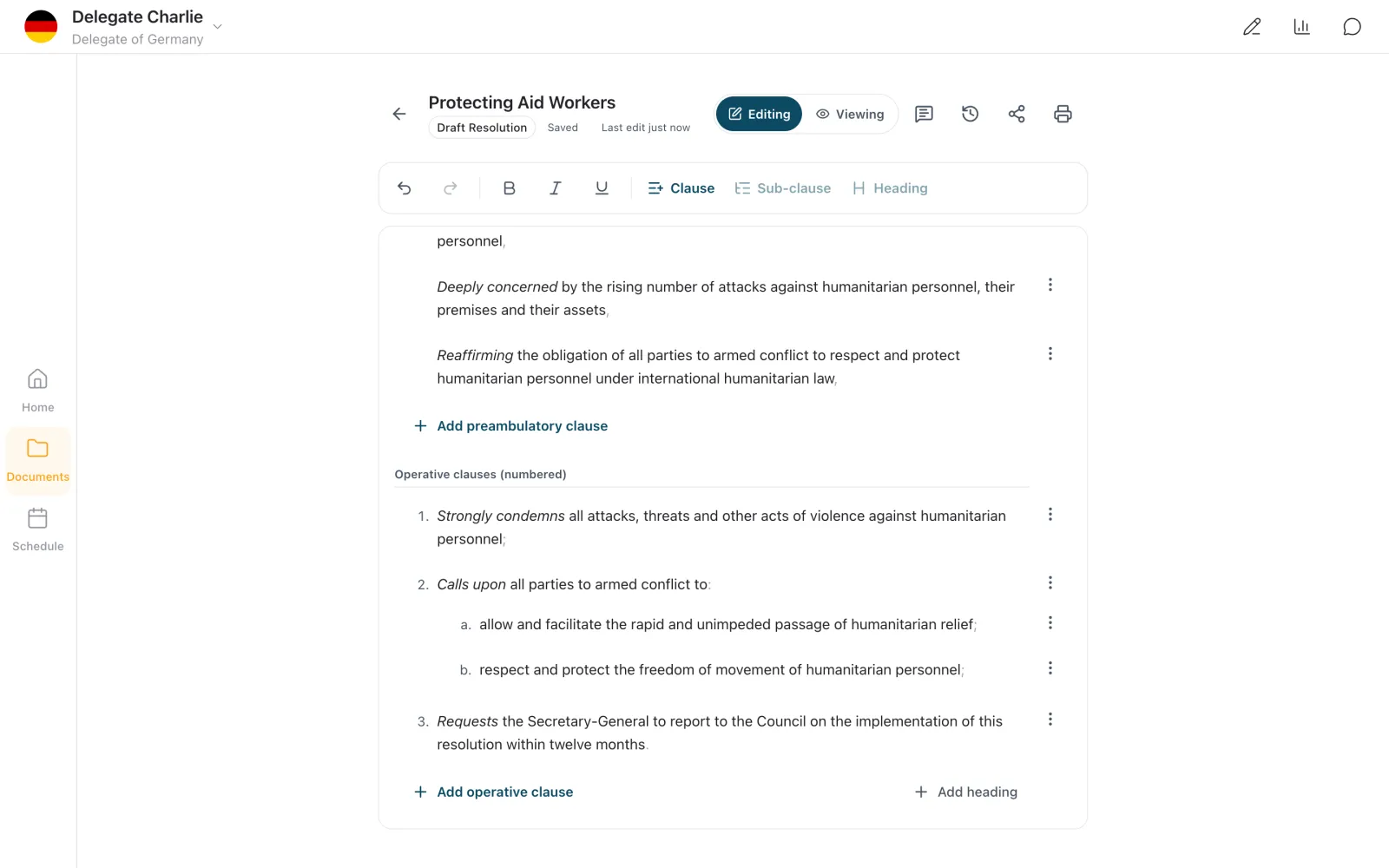
If your conference runs on MUN Command, its document editor suggests opening phrases, numbers your paragraphs and puts your whole bloc in one draft.
Opening words as you type. Click into an empty paragraph and a list of common opening phrases appears. Type a few letters to narrow it, or write your own. Numbers and end marks, done. Operative paragraphs and their subparagraphs number themselves, and a grey end mark shows wherever one is missing. Your bloc in one draft. Sponsors write in the same text at once, and delegates who can only read it suggest changes for the sponsors to accept or reject. A draft from home, sorted. Paste it in or upload a PDF or Word file, and MUN Command sorts it into preambular and operative paragraphs for you to check. One tap to the chair. Request chair approval, and your draft's card shows whether it is pending, approved or needs revising.
Getting it passed
Amendments come first, then the vote on each draft, which usually needs a simple majority.
Common mistakes to avoid
Most errors are format slips, actions in the wrong part and copied text.
Format slips. Underlining where your conference wants italics, a full stop after every paragraph, or “WHO” instead of “World Health Organization”. Check the seven rules before you send your draft, or let MUN Command's editor number it for you. Joining paragraphs with “and”. Each paragraph stands on its own, as in UN resolutions. Actions in the preamble. “Recalling” and “Deeply concerned” give reasons. Anything you want done goes in an operative paragraph. “This resolution” in a General Assembly draft. The General Assembly writes “the present resolution”; “this resolution” is Security Council style. Copied or AI-written text. Many conferences reject both, so write your own paragraphs.
You can now format a draft resolution and write paragraphs that say who acts.
- Make this operative paragraph strong: not practised yet
Find your next conference
306 conferences are taking applications on mymun right now.
Unity And Internationality Model United Nations
Applications close Nov 15, 2026
- High school and university
- Delegates aged 13 to 21
- Delegate fee 167 Zloty, about 38 euros
- About 100 delegates expected

World Diplomats Istanbul
Applications close Nov 15, 2026
- High school and university
- Delegates aged up to 35
- Delegate fee 429 US Dollar, about 384 euros
- About 200 delegates expected