Most people discover Model UN through a General Assembly committee: a large room, a formal debate, a topic you spend weeks researching. Then someone tells you there's a slot open in the crisis committee, and suddenly you're in a completely different world. Faster, messier, and honestly, a lot more fun.
If you've been assigned to a mun crisis committee and aren't quite sure what you've signed up for, this guide will get you ready. If you're simply curious whether crisis is for you, it should answer that too.
What is a crisis committee?
A crisis committee is a small, fast-paced MUN committee where delegates respond to unfolding, fictional emergencies in real time rather than debating a pre-set topic over a fixed agenda.
That's the key difference from a General Assembly committee. In a GA committee, you know the topic before you arrive. You research, you write a position paper, and the debate unfolds in a fairly predictable arc: speeches, caucuses, resolution. The outcome is a document.
In a crisis committee, the situation changes constantly. You might arrive to a room playing the United Nations Security Council scrambling to contain a nuclear standoff, or a cabinet of advisors to a fictional head of state navigating a coup. New developments drop throughout the session in the form of "crisis updates," and your job is to react. The format rewards quick thinking over deep preparation, and the ability to adapt over the ability to stick to a plan.
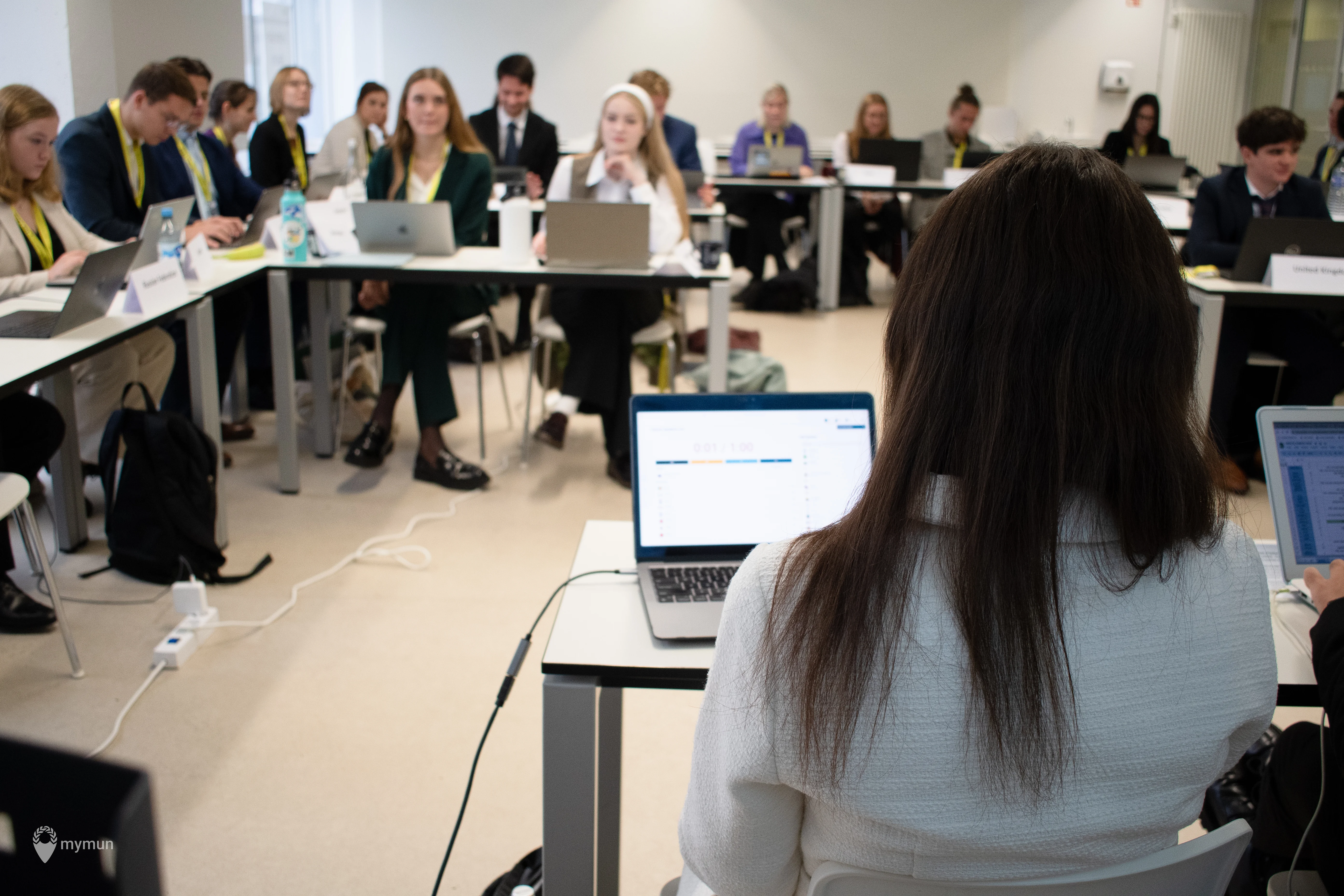
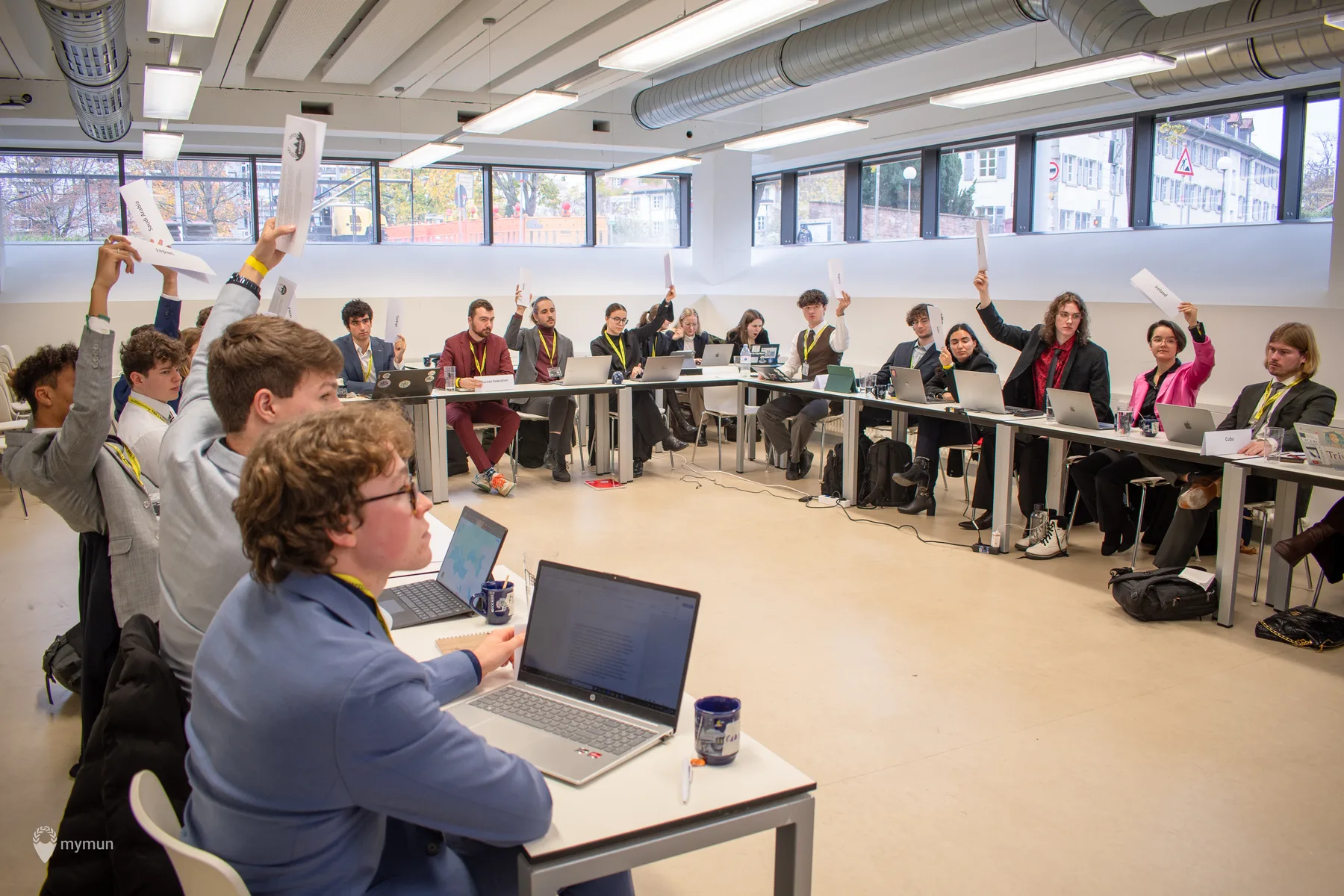
Crisis committees are also much smaller than GA committees, typically 15 to 30 delegates, which means there's nowhere to hide. Everyone talks, everyone writes, and everyone matters.
How crises and crisis updates work
A crisis committee runs on a loop. The committee is given an opening scenario, delegates begin debating and taking action, and then the crisis staff (a team working behind the scenes, sometimes literally in a backroom) injects new developments into the session.
These new developments are the crisis updates. They arrive as dramatic announcements read to the room: a ceasefire has collapsed, a key ally has switched sides, a new video has emerged online. Each update changes what the room needs to do next. The debate that felt settled ten minutes ago is suddenly irrelevant.
The committee responds with directives: formal instructions the committee passes collectively. A directive might deploy peacekeeping troops, authorize a press statement, or demand a meeting with a foreign leader. Directives go to the crisis staff, who decide how events respond.
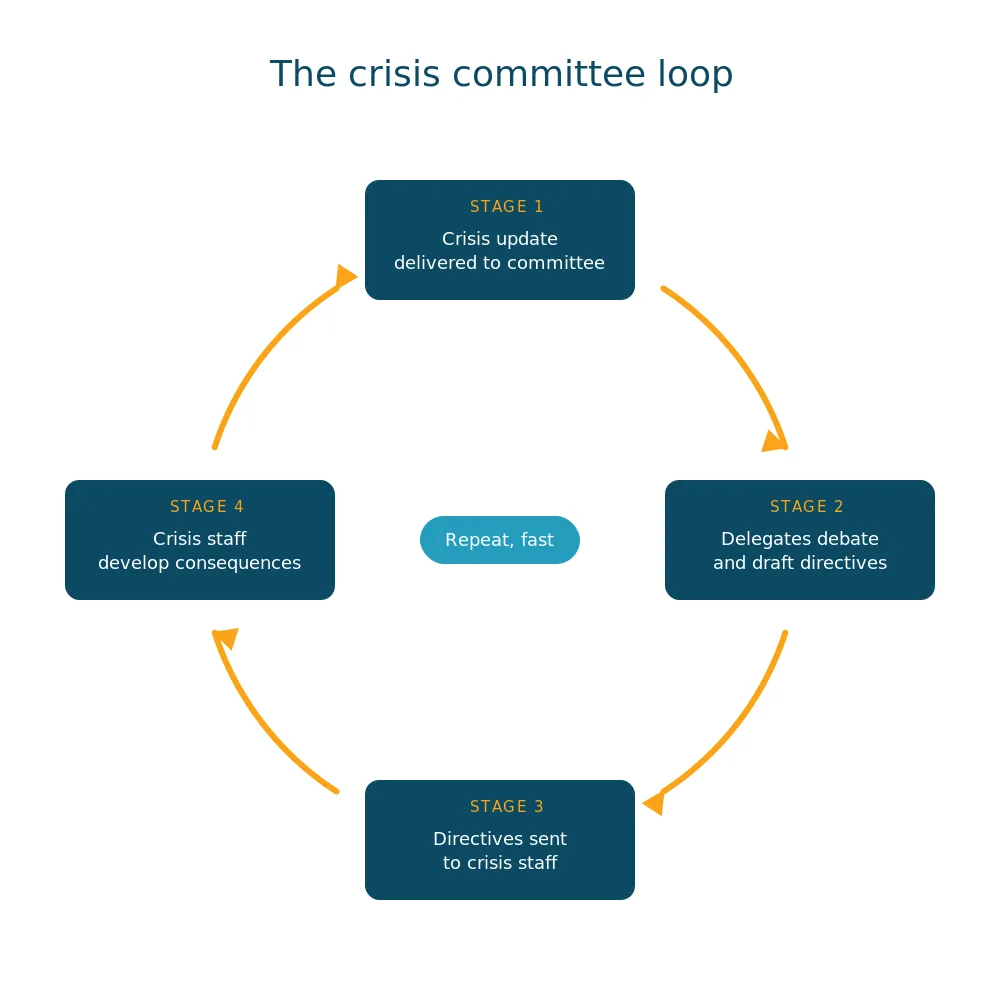
Alongside this committee-level action runs a parallel track called crisis notes, which are individual, private actions that each delegate takes in their own name. This is sometimes called the "backroom" or "personal directives." More on that in the next section.
Directives and crisis notes
Understanding the difference between these two is the single most useful thing you can learn before your first crisis session.
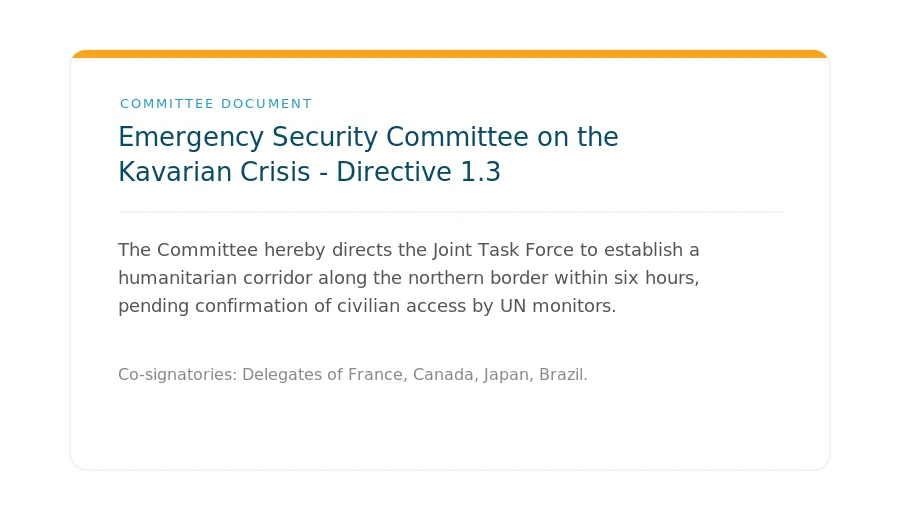
Directives are collective. The committee debates them, votes on them, and sends them as the group's official action. They work similarly to resolutions in a GA committee, though they're much shorter and faster to write. A directive typically has a header identifying who is sending it, a one-line operative clause, and the signatures of enough delegates to pass.
Here's a short example of how a directive might read:
Crisis notes (or personal directives) are something else entirely. They're written by individual delegates and sent secretly to the crisis staff, representing private actions your character is taking outside the committee room: calling a contact, moving assets, leaking information. The crisis staff decides how those actions land and may feed the results back to you, or into the committee as a new update.
Crisis notes are where the richest storytelling happens. They're also where beginners tend to get stuck, because it isn't obvious at first that you're supposed to be doing this at all. When you sit down in your first crisis session, start writing notes early. Even small actions, checking in with an ally, requesting a briefing, establishing a back-channel, show the crisis staff you're engaged and tend to pay off later.
Beginner survival tips
If you're walking into your first crisis committee, the biggest adjustment isn't procedural. It's mental. Here's what actually helps.
Move at crisis speed. GA committees reward patience. Crisis committees punish hesitation. If you draft the perfect directive but three other delegates already passed a messier version while you were polishing your language, their version is the one that matters. Done is better than perfect. Get something on paper, find co-signatories, and move.
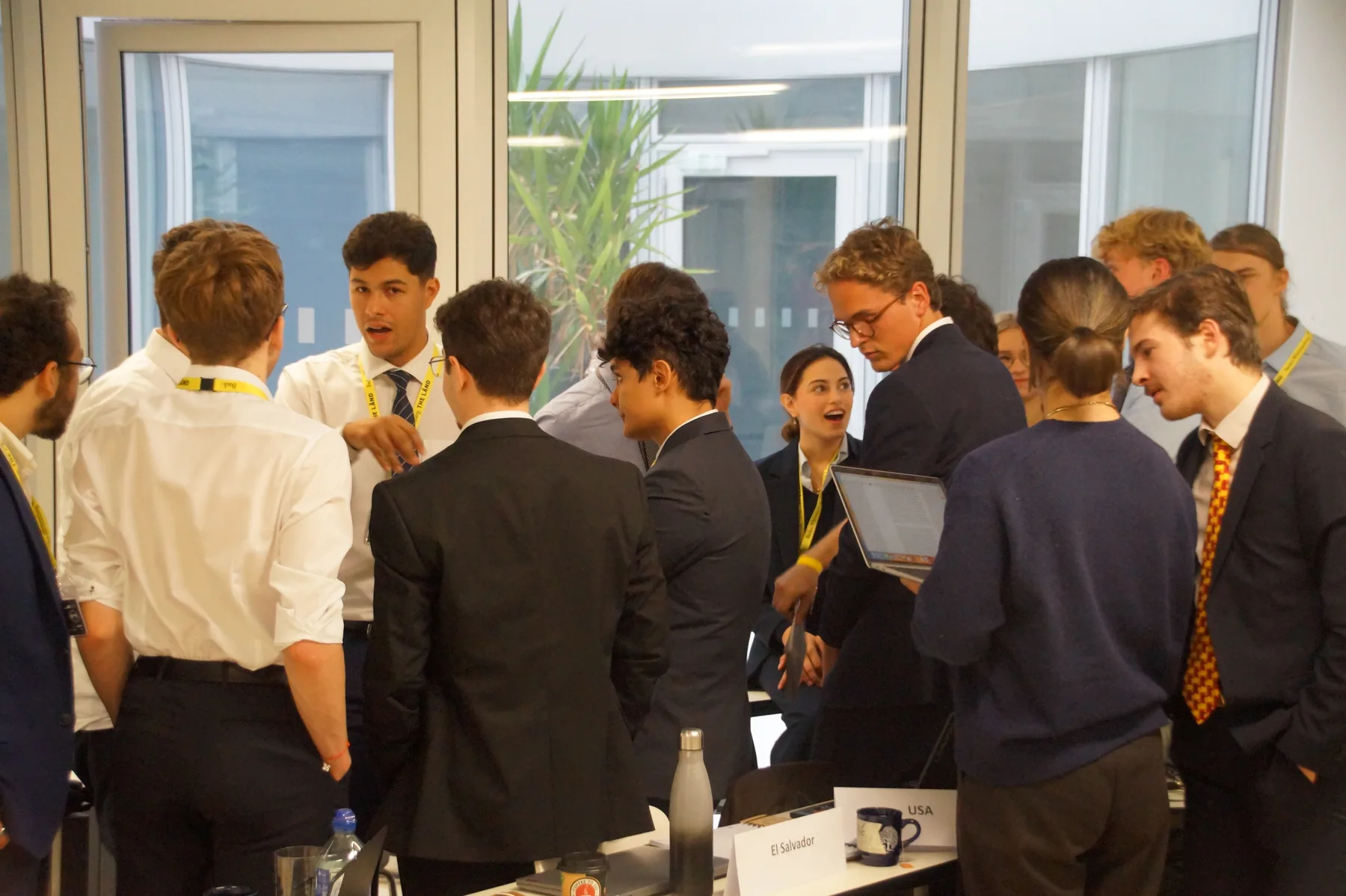
Build alliances in the first twenty minutes. In a crisis committee, who you know in the room matters enormously. Find two or three delegates whose characters have compatible goals and make them your default partners. You don't need a formal bloc: just a working understanding that you'll co-sign each other's directives and share information from your crisis notes.
Stay in character, especially when things get absurd. Crisis scenarios are often fictional, and they sometimes get very strange. A pandemic with an implausible origin. A technology that doesn't exist. A political crisis in a country nobody has heard of. The room works best when everyone commits to the fiction. Treat it seriously, argue as your character would argue, and trust the crisis staff to keep it coherent.
Don't wait for permission to act. Crisis committees are one of the few MUN formats where being proactive is always the right instinct. If you see a gap in the committee's strategy, draft a directive to fill it. If you have an idea for a crisis note, send it. The worst outcome is that the crisis staff ignores it. The best outcome is that it shapes the next fifteen minutes for the entire room.
Read every crisis update carefully. It sounds obvious, but in a fast-moving session it's easy to half-listen while you're drafting. Crisis updates almost always contain clues about what the staff is responding to and what they're setting up next. The delegates who read closely tend to stay ahead of the room.
Going deeper
This guide gives you the foundation for your first session. But crisis committee is a format with real depth, and the more you do it, the more layered it becomes.
For the full strategic picture, including how experienced delegates use fictional scenarios to explore genuinely interesting ideas, take a look at A Case for Fictional Crisis Committees. It's the advanced angle: why the fiction is the point, and how to use it well.
If you're still finding your feet in MUN more broadly, What Is Model UN? and the complete beginner's guide to your first MUN will give you the wider context that makes crisis committee easier to understand.
Crisis is where a lot of delegates discover what they actually love about MUN. Go in curious, move fast, and write more notes than you think you need to. You'll find your footing quickly.