Researchers have found plastic particles in human blood, yet the latest draft of the global plastics treaty has no article on health. On 13 November 2026, more than 400 young people from over 50 countries, meeting at WHO headquarters in Geneva for Global Model WHO, adopted a Youth Declaration on Plastics and Health. Their message to the negotiators: put health in the treaty. You can back it by adding your own commitment to a world map.
"We grew up hearing about plastics as a problem for the oceans. With this declaration, we make clear that it is a problem for our health too," said Alexander Dietz, Director-General of Global Model WHO 2026. "Most of the plastic ever produced was made during our lifetimes, and we are the ones who will live with it. So, we ask the negotiators to put health in the treaty, and we commit to doing our part at home."
The declaration at a glance
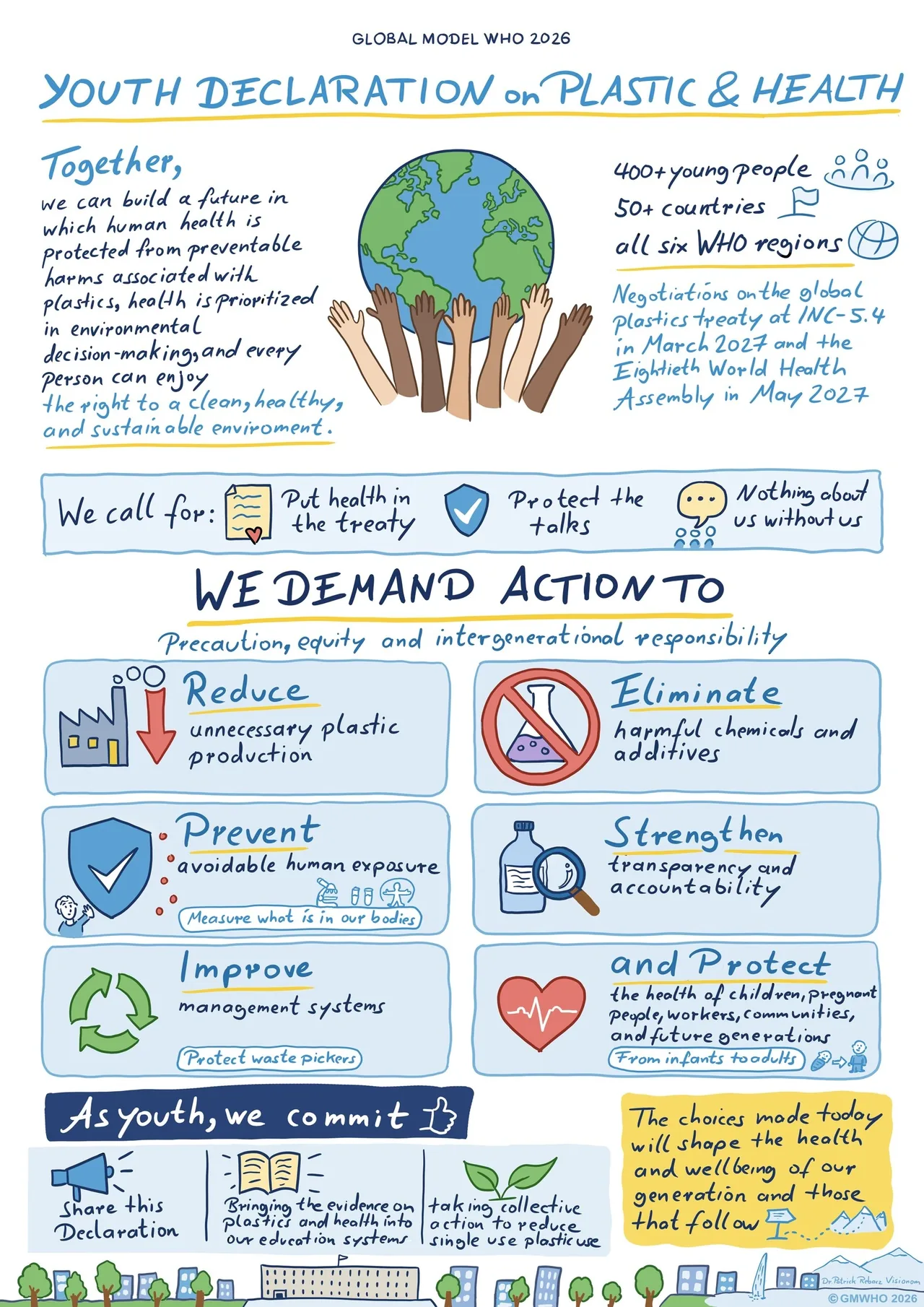
Illustration: Dr. Patrick Rebacz (Visionom), © GMWHO 2026.
The declaration's summary opens with its vision: "Together, we can build a future in which human health is protected from preventable harms associated with plastics, health is prioritized in environmental decision-making, and every person can enjoy the right to a clean, healthy, and sustainable environment."
- For the treaty talks: put health in the treaty, protect the talks, and nothing about us without us.
- For action, guided by precaution, equity and intergenerational responsibility: reduce unnecessary plastic production, eliminate harmful chemicals and additives, prevent avoidable human exposure, strengthen transparency and accountability, improve waste management systems, and protect the health of children, pregnant people, workers, communities and future generations.
- As youth, the delegates commit to: share the declaration, bring the evidence on plastics and health into education, and take collective action to reduce single-use plastic.
Why plastics are a health issue
The declaration starts from what plastic does well, from essential medical equipment to food safety. Its concern is the cost to our health, a cost that "does not affect us all equally."
- More than 16,000 chemicals are used or found in plastics. At least one in four is hazardous, and for most of the others there is no data on the health risks.
- Researchers have found plastic particles in human blood, brain tissue and amniotic fluid (the fluid around a baby in the womb), so exposure can begin before birth.
- On current trends, plastic production will nearly triple by 2060, "when most of us will be in our fifties."
Scientists are still working out how to measure micro- and nanoplastics (tiny plastic particles, many too small to see) and what they do to the body. The delegates see that gap as a reason to act now: "We should not have to be the test subjects to find out what we still don't know."
Why 2027 matters
Two meetings in 2027 will decide how much health counts. In March, governments meet again to negotiate the global plastics treaty (the round is called INC-5.4). In May, health ministers meet at the Eightieth World Health Assembly, WHO's yearly decision-making meeting. The declaration speaks to both, and the timing matters: the latest treaty draft, written by the chair of the talks in August 2026, has no article on health.
What the declaration asks
The preamble ends: "We had no say in growing up this way. We want the children being born now to be better protected than we are. This is what we ask."
Then come 11 calls: three for the treaty talks, and eight that follow plastic from the factory to our bodies to the dump.
In the treaty talks
1. Put health in the treaty. Write binding duties to protect human health throughout the treaty text, and bring health ministries into every national delegation.
2. Protect the talks. Keep companies with a stake in the outcome, such as the plastics and petrochemical industries, out of the negotiations, whether as observers, delegation members or sponsors. The WHO tobacco treaty already does this for the tobacco industry.
3. Nothing about us without us. Give young people a formal role in decisions on plastics and health, and include youth representatives in national delegations through the WHO Youth Delegate Program.
Before plastic reaches us: production and chemicals
4. Reduce unnecessary plastic production and use. Set clear, measurable targets to cut plastic production step by step, adjusted to each country's situation.
5. Phase out chemicals of concern. Start with the most harmful and make sure the replacements are really safer. Companies should disclose what their plastics contain and answer for the harm they cause.
In our daily lives: food, air and our bodies
6. Measure what is in our bodies. WHO should set up an independent expert process, before the Eightieth World Health Assembly, to agree on standard ways of measuring plastic chemicals and particles in the human body. It should help countries in all six WHO regions run these tests and report on the evidence in plain language every two years.
7. Prevent exposure. Find and cut avoidable sources of micro- and nanoplastics in everyday products, food, drinking water, and indoor and outdoor spaces, starting with the people most at risk: children, pregnant people and exposed workers.
8. Communicate transparently. WHO and national health authorities should explain what is known, what is still uncertain and what they are doing about it, instead of putting the responsibility on individual consumers.
After we throw it away: waste and healthcare
9. Treat waste management as a health investment. Fund safe waste systems as a basic public health service, end open burning and dumping, and stop exporting plastic waste and its health burden to other countries.
10. Protect waste pickers. Give the people who collect and sort waste for a living recognition, a place in formal waste systems, safe working conditions and social protection, and end child labor in dumpsites.
11. Safer plastics in healthcare, from infants to adults. WHO should report on healthcare plastics to the Eightieth World Health Assembly. Treaty negotiators should require a clear reason for every chemical of concern still used in medical devices, starting with products for babies and pregnant people. Any exemption must be time-limited, reviewed regularly and based on proven need, never automatic.
Debating plastics or global health at your next conference? These 11 calls give you a ready-made set of ideas to research and turn into operative paragraphs.
Your turn: add your commitment to the map
The delegates did more than make demands: they made commitments of their own, and those who study or work in healthcare will also speak up about avoidable plastic there, without putting patients at risk. Now you can add a commitment of your own. The WHO Youth Council and WFUNA collect them on a public world map:
- Open padlet.com/WHOYouthCouncil/PlasticsHealth.
- Tap or click + and pin your location.
- Add your first name or a nickname, your age group and one personal commitment to reduce the health harms of plastics. Need an idea? Swap a single-use item you buy every week for a reusable one, ask your school canteen about its packaging, or put plastics and health on your MUN club's agenda.
Posts are public and lightly moderated, so leave out your full name. Every pin shows the negotiators how many young people want health in the treaty.
To go further, read the full declaration and share it with your MUN club, your school and your country's ministry of health.
About Global Model WHO
Global Model WHO is a student-led simulation of the World Health Assembly. WFUNA organizes it every year with WHO, and plastics and health was one of six committees in 2026. You can take part as a high school or university student in any subject, on your own or with your school's or university's delegation. WFUNA's Global Model WHO page and WHO's initiative page have the details.
If you have been to a Model UN conference, the format will feel familiar: you represent a country, research its position, give speeches, negotiate in committee and draft a resolution. The difference is the setting, WHO headquarters, and the topics, taken from the real World Health Assembly agenda. Until the next edition, practice at a conference near you: plenty of Model UN conferences run a WHO committee, and you can browse upcoming health topics and climate and environment topics.
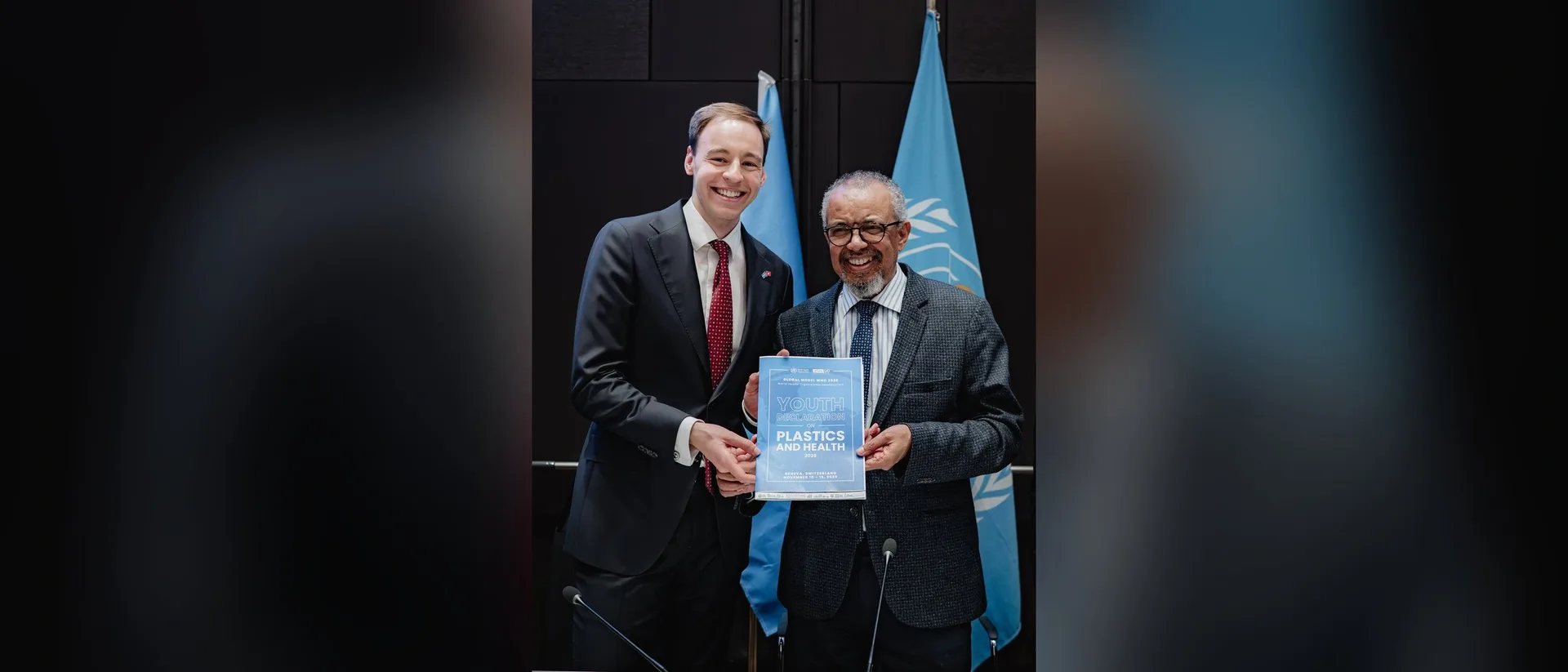
WHO Director-General Dr. Tedros Adhanom Ghebreyesus had a message for this year's delegates: "Keep asking hard questions. Keep looking for the deal that others say cannot be done."
Thank you
This declaration belongs to the more than 400 delegates who debated, negotiated and adopted it in Geneva. Thank you to everyone who contributed to it: Aisha Al-Naimi, Iris Martine Blom, Merwin Denny, Alexander Dietz, Francisco Ferraz, Karla Daniela Lara Chávez, Jaclyn Lo, Max Rothe van Deventer, Yuanzhen Xu and Yusuf Auwal Yahya. Thank you to Ana Paulina Acosta Aguilar, who designed the declaration, to Dr. Patrick Rebacz (Visionom), who drew its summary, and to Bennett Bashir for the photo. And thank you to WFUNA and WHO for bringing everyone together.
"The choices made today will shape the health and wellbeing of our generation and those that follow." The treaty talks resume in March. Put your pin on the map before they do: padlet.com/WHOYouthCouncil/PlasticsHealth.
Cover photo: Bennett Bashir.