TOSMUN 2026

TOSMUN

Aug 15–16, 2026 Calicut, India

TOSMUN

Conference

Calicut, India·Asia

Aug 15–16, 2026

High school students

In English

Applications

Closed
  • ObserversJun 27 – Aug 14, 2026
  • DelegatesJun 25 – Jul 15, 2026
  • Faculty advisorsJun 27 – Jul 8, 2026

About

Debate.Delibrate.Decide Tomorrow.

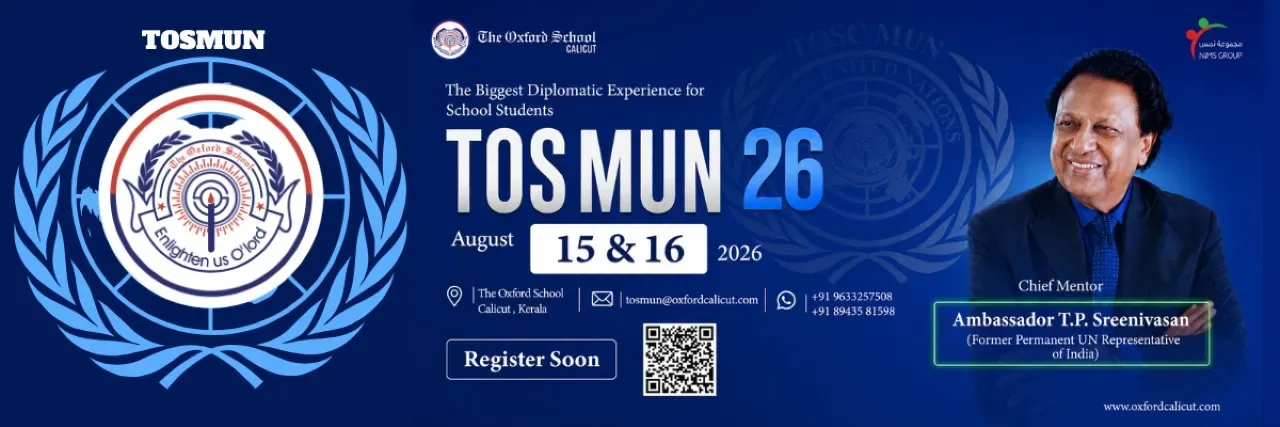
TOSMUN'26 – The First Edition is the inaugural inter-school Model United Nations conference hosted by The Oxford School, Calicut. Bringing together students from across the region, TOSMUN aims to provide a platform for diplomacy, critical thinking, negotiation, and public speaking through realistic simulations of international and national decision-making.

With carefully curated committees, experienced Executive Board members, and a commitment to academic excellence, TOSMUN offers delegates an engaging environment to debate pressing global and domestic issues while developing leadership, research, and collaboration skills.

Whether you are attending your first conference or are an experienced delegate, TOSMUN strives to deliver a professional, inclusive, and memorable MUN experience that challenges participants to think critically, negotiate effectively, and lead with purpose.

Host: The Oxford School, Calicut
Conference Type: Inter-School Model United Nations
Committees: UNGA, UNHRC, UNSC (CCC), Kerala Legislative Assembly (KLA)

Committees

  • 52 countries
    1. “Deliberation on the concept of veto power and its impact on third world countries in the Global South"

    UNGA

    Beginner · English · 52 countries

    Topic

    “Deliberation on the concept of veto power and its impact on third world countries in the Global South"

    About the committee

    The United Nations General Assembly (UNGA) is the principal deliberative body of the United Nations, bringing together all 193 Member States to discuss and address the world's most pressing political, economic, humanitarian, and social challenges. Operating on the principle of sovereign equality, every Member State has one vote, fostering diplomacy, consensus-building, and multilateral cooperation. In this committee, delegates will represent their assigned Member States to debate complex international issues, negotiate resolutions, and build consensus through formal debate and diplomacy. UNGA provides an ideal platform for both experienced and first-time delegates to develop negotiation, public speaking, and policy-making skills in a realistic diplomatic environment.

    Countries

    How this committee type works
  • 25 countries

    The **Kerala Legislative Assembly (KLA)** is the unicameral legislature of the Indian state of Kerala and serves as the primary law-making body of the state government. Comprising elected Members of the Legislative Assembly (MLAs), the Assembly debates state policies, introduces and scrutinizes legislation, and holds the executive accountable through parliamentary procedure. In this simulation, delegates will represent political parties and key stakeholders within the Assembly, engaging in debates, negotiations, and legislative decision-making on issues of state governance. Participants are expected to balance political strategy, constitutional principles, and public interest while navigating the dynamics of a democratic legislature. The Kerala Legislative Assembly committee offers delegates a unique opportunity to experience Indian parliamentary procedure, coalition politics, and policy-making in a realistic and engaging environment.

    Kerala Legislative Assembly

    Intermediate · English · 25 countries

    About the committee

    The **Kerala Legislative Assembly (KLA)** is the unicameral legislature of the Indian state of Kerala and serves as the primary law-making body of the state government. Comprising elected Members of the Legislative Assembly (MLAs), the Assembly debates state policies, introduces and scrutinizes legislation, and holds the executive accountable through parliamentary procedure. In this simulation, delegates will represent political parties and key stakeholders within the Assembly, engaging in debates, negotiations, and legislative decision-making on issues of state governance. Participants are expected to balance political strategy, constitutional principles, and public interest while navigating the dynamics of a democratic legislature. The Kerala Legislative Assembly committee offers delegates a unique opportunity to experience Indian parliamentary procedure, coalition politics, and policy-making in a realistic and engaging environment.

    Countries

  • 40 countries

    The United Nations Human Rights Council (UNHRC) is an intergovernmental body responsible for promoting and protecting human rights worldwide. It addresses situations involving human rights violations, encourages dialogue among Member States, and develops recommendations to strengthen the international human rights framework. Within this committee, delegates will examine contemporary human rights challenges through diplomacy, negotiation, and international law. Participants are expected to propose practical and balanced solutions while considering humanitarian concerns, state sovereignty, and global cooperation.

    UNHRC

    Intermediate · English · 40 countries

    About the committee

    The United Nations Human Rights Council (UNHRC) is an intergovernmental body responsible for promoting and protecting human rights worldwide. It addresses situations involving human rights violations, encourages dialogue among Member States, and develops recommendations to strengthen the international human rights framework. Within this committee, delegates will examine contemporary human rights challenges through diplomacy, negotiation, and international law. Participants are expected to propose practical and balanced solutions while considering humanitarian concerns, state sovereignty, and global cooperation.

    Countries

    How this committee type works
  • 20 countries

    The United Nations Security Council (UNSC) is the United Nations' primary body responsible for maintaining international peace and security. Comprising fifteen Member States, including five permanent members with veto powers, the Council responds to international crises through diplomacy, peacekeeping mandates, sanctions, and other measures authorized under the UN Charter. In this simulation, delegates will navigate high-stakes geopolitical challenges, negotiate rapidly evolving situations, and draft resolutions aimed at preserving international peace and security. The committee demands strategic thinking, diplomacy, and decisive action while balancing national interests with global stability.

    UNSC (CCC)

    Expert · English · 20 countries

    About the committee

    The United Nations Security Council (UNSC) is the United Nations' primary body responsible for maintaining international peace and security. Comprising fifteen Member States, including five permanent members with veto powers, the Council responds to international crises through diplomacy, peacekeeping mandates, sanctions, and other measures authorized under the UN Charter. In this simulation, delegates will navigate high-stakes geopolitical challenges, negotiate rapidly evolving situations, and draft resolutions aimed at preserving international peace and security. The committee demands strategic thinking, diplomacy, and decisive action while balancing national interests with global stability.

    Countries

    How this committee type works
  • 43 countries

    Please refer to the official country matrix
    UNW

    Beginner · English · 43 countries

    About the committee

    Please refer to the official country matrix
    Countries

    How this committee type works

Organizers

More MUN conferences

ConferencesIndiaTOSMUN 2026