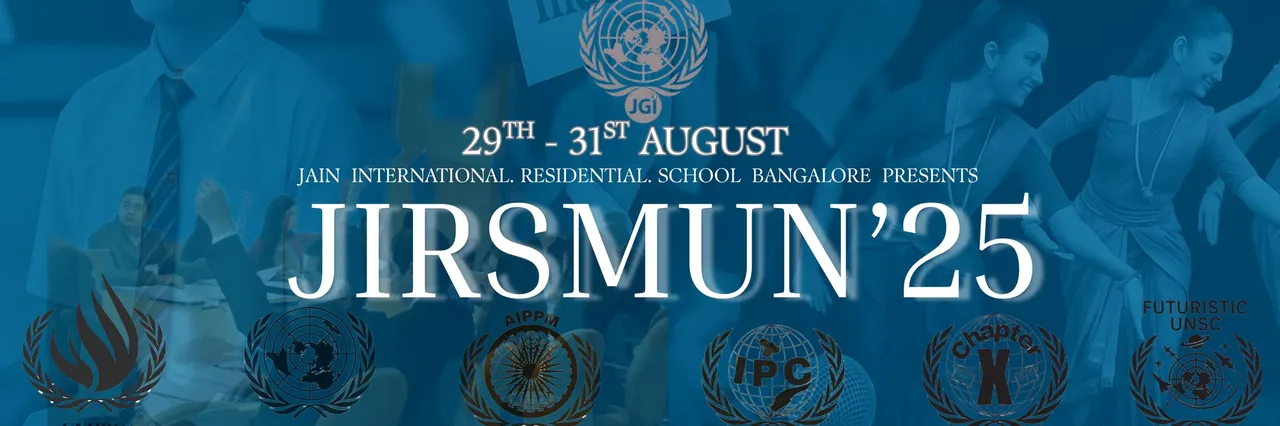
JIRSMUN 2025

Jain International Residential School Model United Nations

Aug 29–31, 2025 Bengaluru, India

Jain International Residential School Model United Nations

Latest edition: TSA Global mun 2026Feb 28 – Mar 1, 2026

Conference

Bengaluru, India·Asia

Aug 29–31, 2025

300 delegates expected

High school students

In English

How it went

4.3528 ratings from delegates
Academics
4.39
Logistics
4.43
Socials
4.21

About

Now in its seventh edition, JIRSMUN—hosted on the scenic 350-acre campus of Jain International Residential School (JIRS)—is a prestigious Model United Nations conference that brings together the spirit of high-level diplomacy, critical debate, and vibrant cultural exchange. Having successfully hosted six prior editions, JIRSMUN has become a hub for delegates from across the country to engage in rigorous negotiations, draft impactful resolutions, and participate in meaningful dialogue on global issues. More than a forum for debate, the conference fosters cross-cultural understanding, encouraging participants to form lasting bonds while embracing diverse perspectives.

With delegate packages priced at ₹1,600 (non-residential) and ₹4,500 (residential), JIRSMUN offers an immersive experience rooted in inclusivity, academic excellence, and internationalism—all set within the world-class learning environment of JIRS.

Committees

  • 50 countries

    In a world hurtling toward uncharted geopolitical terrains, the Futuristic United Nations Security Council convenes not as a body of tradition, but as an assembly of visionary diplomacy and urgent action. Tasked with addressing conflicts that transcend today’s borders, technologies, and ideologies, delegates must navigate the volatile complexities of artificial intelligence in warfare, space militarization, cyber sovereignty, and shifting power balances. This crisis committee is not merely a simulation of diplomacy—it is an intellectual battlefield where decisions taken in the moment alter the trajectory of humanity. Delegates must respond to escalating crises in real time, where every communiqué, every resolution, and every alliance could determine the fate of the international order in decades to come.
    • Abhav R Nair

    Futuristic United Nations Security Council

    Expert · English · 50 countries

    About the committee

    In a world hurtling toward uncharted geopolitical terrains, the Futuristic United Nations Security Council convenes not as a body of tradition, but as an assembly of visionary diplomacy and urgent action. Tasked with addressing conflicts that transcend today’s borders, technologies, and ideologies, delegates must navigate the volatile complexities of artificial intelligence in warfare, space militarization, cyber sovereignty, and shifting power balances. This crisis committee is not merely a simulation of diplomacy—it is an intellectual battlefield where decisions taken in the moment alter the trajectory of humanity. Delegates must respond to escalating crises in real time, where every communiqué, every resolution, and every alliance could determine the fate of the international order in decades to come.

    Chair

    Countries

    How this committee type works
  • 50 countries

    Amidst the smoldering embers of the recent attack on Pahalgam, which has once again ignited tensions across the Line of Control, the All India Political Parties Meet (AIPPM) convenes at a critical juncture in India’s contemporary history. As the nation grapples with the mounting pressures of external aggression and internal political polarization, this platform becomes the crucible for forging national consensus—or discord. Delegates representing India's diverse political spectrum must debate and deliberate on the most pressing issues, assess the adequacy of the current security operations, and consider the path forward. In this high-stakes environment, the AIPPM does not merely reflect political theatre—it becomes the arena where democracy must confront conflict with clarity, conviction, and constitutional responsibility.

    All India Political Party Meet

    Expert · English · 50 countries

    About the committee

    Amidst the smoldering embers of the recent attack on Pahalgam, which has once again ignited tensions across the Line of Control, the All India Political Parties Meet (AIPPM) convenes at a critical juncture in India’s contemporary history. As the nation grapples with the mounting pressures of external aggression and internal political polarization, this platform becomes the crucible for forging national consensus—or discord. Delegates representing India's diverse political spectrum must debate and deliberate on the most pressing issues, assess the adequacy of the current security operations, and consider the path forward. In this high-stakes environment, the AIPPM does not merely reflect political theatre—it becomes the arena where democracy must confront conflict with clarity, conviction, and constitutional responsibility.

    Countries

    How this committee type works
  • 50 countries

    The United Nations Human Rights Council stands as a paragon of global justice, entrusted with the solemn responsibility of upholding and safeguarding the fundamental rights and freedoms enshrined in international law. In this committee, delegates are called upon to confront the gravest human rights violations of our time—from mass surveillance and digital repression to ethnic cleansing, refugee displacement, and systemic discrimination. This is a forum where words carry weight, empathy meets policy, and delegates must bridge ideological divides to forge resolutions that transcend national interests in the pursuit of universal dignity. The UNHRC challenges every delegate to think globally and act morally.

    United Nations Human Rights Council

    Intermediate · English · 50 countries

    About the committee

    The United Nations Human Rights Council stands as a paragon of global justice, entrusted with the solemn responsibility of upholding and safeguarding the fundamental rights and freedoms enshrined in international law. In this committee, delegates are called upon to confront the gravest human rights violations of our time—from mass surveillance and digital repression to ethnic cleansing, refugee displacement, and systemic discrimination. This is a forum where words carry weight, empathy meets policy, and delegates must bridge ideological divides to forge resolutions that transcend national interests in the pursuit of universal dignity. The UNHRC challenges every delegate to think globally and act morally.

    Countries

    How this committee type works
  • 35 countries

    Where literature meets diplomacy and narrative is no longer bound by ink, Chapter X reimagines the very framework of crisis committees. Delegates are assigned iconic characters from a carefully selected novel and are immersed at the Freeze Date—the critical moment in the story where the plot halts and diplomacy begins. From this inflection point, the canon dissolves. Through meticulously crafted crisis directives, clandestine notes, spontaneous alliances, and calculated decisions, delegates wield the power to redirect the course of the narrative itself.

    Chapter X

    Beginner · English · 35 countries

    About the committee

    Where literature meets diplomacy and narrative is no longer bound by ink, Chapter X reimagines the very framework of crisis committees. Delegates are assigned iconic characters from a carefully selected novel and are immersed at the Freeze Date—the critical moment in the story where the plot halts and diplomacy begins. From this inflection point, the canon dissolves. Through meticulously crafted crisis directives, clandestine notes, spontaneous alliances, and calculated decisions, delegates wield the power to redirect the course of the narrative itself.

    Countries

  • 20 countries

    In times of war, truth becomes the first casualty—and the International Press Corps emerges as the final line of defense against misinformation, sensationalism, and propaganda. With the Indo-Pak conflict dominating headlines following the Pahalgam tragedy, the press finds itself at the epicenter of a narrative war. As regional tensions flare and digital misinformation campaigns proliferate, the IPC bears the onus of delivering timely, accurate, and unbiased reportage. Delegates must navigate the fine line between journalistic integrity and national interest, balancing freedom of expression with the imperative of responsibility. In this committee, the pen is indeed mightier than the sword—for the stories that are told, the headlines that are written, and the truth that is uncovered may determine not just public opinion, but the course of diplomatic history itself.

    International Press Corps

    Intermediate · English · 20 countries

    About the committee

    In times of war, truth becomes the first casualty—and the International Press Corps emerges as the final line of defense against misinformation, sensationalism, and propaganda. With the Indo-Pak conflict dominating headlines following the Pahalgam tragedy, the press finds itself at the epicenter of a narrative war. As regional tensions flare and digital misinformation campaigns proliferate, the IPC bears the onus of delivering timely, accurate, and unbiased reportage. Delegates must navigate the fine line between journalistic integrity and national interest, balancing freedom of expression with the imperative of responsibility. In this committee, the pen is indeed mightier than the sword—for the stories that are told, the headlines that are written, and the truth that is uncovered may determine not just public opinion, but the course of diplomatic history itself.

    Countries

    How this committee type works
  • 54 countries

    The Disarmament and International Security Committee (DISEC) is the First Committee of the United Nations General Assembly. It addresses matters of global peace, disarmament, and threats to international security. DISEC works on issues like arms control, WMD non-proliferation, and regional security, making recommendations without legally binding authority.

    Disarmament and International Security Committee

    Beginner · English · 54 countries

    About the committee

    The Disarmament and International Security Committee (DISEC) is the First Committee of the United Nations General Assembly. It addresses matters of global peace, disarmament, and threats to international security. DISEC works on issues like arms control, WMD non-proliferation, and regional security, making recommendations without legally binding authority.

    Countries

    How this committee type works
  • 50 countries

    At the confluence of organized crime, transnational trafficking, and state corruption lies the pivotal domain of the United Nations Office on Drugs and Crime. As criminal networks evolve with technological sophistication and global reach, the UNODC serves as the international vanguard against illicit economies that undermine governance, public health, and global security. Delegates will confront the urgent challenges of narcotics control, cybercrime, human trafficking, and the dark web, all while navigating the delicate balance between sovereignty and international cooperation. This committee demands not only a forensic understanding of global criminal trends but also the moral fortitude to propose innovative, actionable frameworks that can withstand the complexities of enforcement. The future of justice, in many ways, begins here.
    United Nations Office on Drugs and Crime

    Intermediate · English · 50 countries

    About the committee

    At the confluence of organized crime, transnational trafficking, and state corruption lies the pivotal domain of the United Nations Office on Drugs and Crime. As criminal networks evolve with technological sophistication and global reach, the UNODC serves as the international vanguard against illicit economies that undermine governance, public health, and global security. Delegates will confront the urgent challenges of narcotics control, cybercrime, human trafficking, and the dark web, all while navigating the delicate balance between sovereignty and international cooperation. This committee demands not only a forensic understanding of global criminal trends but also the moral fortitude to propose innovative, actionable frameworks that can withstand the complexities of enforcement. The future of justice, in many ways, begins here.
    Countries

    How this committee type works

More MUN conferences

ConferencesIndiaJIRSMUN 2025