Conference
Online
Dec 10, 2026
30 delegates expected
Students of all levels
In English
Applications
Open- DelegatesNov 19 – Dec 5, 2026Open
- ObserversNov 19 – Dec 9, 2026Open
About
🌍 Learn. Speak. Act. Create Change.
About
🌍 Learn. Speak. Act. Create Change.
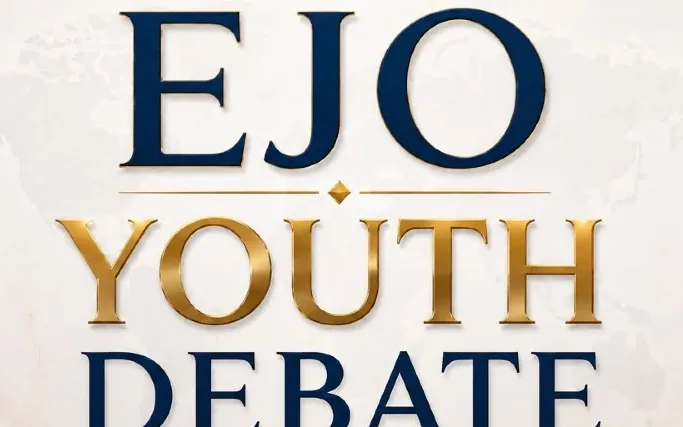
EJO YOUTH DEBATE 2026
📅 Date: 10 December 2026
🕑 Start Time: 2:00 PM IST (08:30 AM UTC)
💻 Format: Online Conference
👥 Total Debators: 30
🎓 Accepted Delegate Level: School , University
⚖️ Format: Two-Team Debate
🏛️ Teams: Proposition & Opposition
👤 Debators per Team: 15
We will be following Oxford Union-style debate
MOTION:
"This House believes that the portrayal of food waste in films and television normalizes wasteful behaviour in society, and eventually affects global food wastage directly/indirectly."
ABOUT THE DEBATE
Food waste is often perceived as an ordinary or insignificant part of everyday life. However, its repeated portrayal in films and television series may contribute to the normalization of wasteful behaviour, particularly among children, pre-teens, and teenagers who are influenced by the actions they observe on screen.
From scenes depicting characters casually abandoning unfinished meals in restaurants to sequences involving food being thrown around for entertainment, the media frequently presents food waste without acknowledging its consequences. Unlike other potentially harmful behaviours, such as smoking, which may be accompanied by health warnings or disclaimers, food waste is rarely addressed in a similar manner.
This raises an important question: does the entertainment industry indirectly encourage a culture in which wasting food is considered normal and socially acceptable?
The issue becomes even more significant when considered against the backdrop of global food insecurity, unequal access to nutritious meals, resource scarcity, and the environmental consequences associated with food production and disposal.
The debate invites participants to examine whether the representation of food waste in films and television can influence real-world attitudes and behaviours, whether this influence contributes to the broader problem of global food waste, and whether the entertainment industry should bear any responsibility for the social consequences of its portrayals.
Participants will be divided into two equally sized teams:
🟢Proposition: Media portrayals of food waste can normalize wasteful behaviour, particularly among children and teenagers, and the media industry has a responsibility to raise awareness.
🔴Opposition: Media largely reflects existing behaviour rather than causing it; food waste is driven more by habits, consumer behaviour, and systemic issues than by fictional portrayals.
Each team will consist of 15 debators, giving participants the opportunity to develop arguments, challenge opposing viewpoints, and work strategically as a team.
🕐 CONFERENCE TIMETABLE — IST
Date: 10 December 2026
Time Zone: Indian Standard Time (IST)
Time| Activity
2:00 PM – 3:00 PM| Session I — Opening & Debate Round I
3:00 PM – 3:20 PM| Break
3:20 PM – 4:20 PM| Session II — Debate Round II
4:20 PM – 4:40 PM| Break
4:40 PM – 5:10 PM| Session III — POI section
5:10 PM - 5:30 PM| Break (decide final speech)
5:30 – 5:40 PM| Final speech
5:40 – 5:55 PM| Break
5:55 – 6:10 PM|Closing ceremony
---
🌐 CONFERENCE TIMETABLE — UTC
Date: 10 December 2026
Time Zone: Coordinated Universal Time (UTC)
Time| Activity
8:30 AM – 9:30 AM | Session I — Opening & Debate Round I
9:30 AM – 9:50 AM | Break
9:50 AM – 10:50 AM | Session II — Debate Round II
10:50 AM – 11:10 AM | Break
11:10 AM – 11:40 AM | Session III — POI Section
11:40 AM – 12:00 AM | Break (Decide final speech)
12:00 AM – 12:10 PM | Final Speech
12:10 PM – 12:25 PM | Break
12:25 PM – 12:40 PM | Closing Ceremony
WHAT TO EXPECT
Participants will be expected to:
- Present clear and well-structured arguments.
- Respond effectively to opposing arguments.
- Use relevant examples and evidence to support their position.
- Demonstrate critical thinking and logical reasoning.
- Engage respectfully with opposing viewpoints.
- Collaborate strategically with their team.
- Maintain professionalism throughout the online conference.
The debate will challenge participants to move beyond simply stating their opinions and instead defend, question, and critically examine their position.
WHO CAN PARTICIPATE?
The debate is open to school-level participants.
With only 30 available delegate positions, participants will be divided equally between the Proposition and Opposition teams.
Proposition — 15 Debators
Opposition — 15 Debators
🌐 Join the Conversation
Question the norm. Challenge the argument. Defend your position.
EJO Youth Debate 2026 — Where Young Voices Meet Strong Arguments.
Committees
The proposition argues that the repeated portrayal of food waste in films and television can normalize wasteful behaviour, particularly among young audiences who are impressionable. By presenting food wastage as harmless or entertaining, the media may shape attitudes that contribute to real-world waste. Therefore, the entertainment industry should acknowledge its influence and take greater responsibility for promoting awareness of food waste and its consequences.
The opposition argues that food waste depicted in films and television is primarily a reflection of real-life behaviour rather than a direct influence on it. Entertainment is meant to portray stories, not dictate social conduct, and viewers are capable of distinguishing fictional scenes from real-world responsibilities. Holding the entertainment industry accountable for food waste risks overstating its influence while overlooking the deeper causes of food wastage, such as consumer habits, poor food management, and systemic inefficiencies.
Past editions
- Academics
- 3.8
- Logistics
- 2.7
- Socials
- 3.5
Organizers

More MUN conferences
OnlineOnline MUN conferences December 2026MUN conferences in December 2026 High school MUNMUN conferences for high school students University MUNMUN conferences for university students
ConferencesOnlineYouth debate II 2026