
TOYO MUN 2023

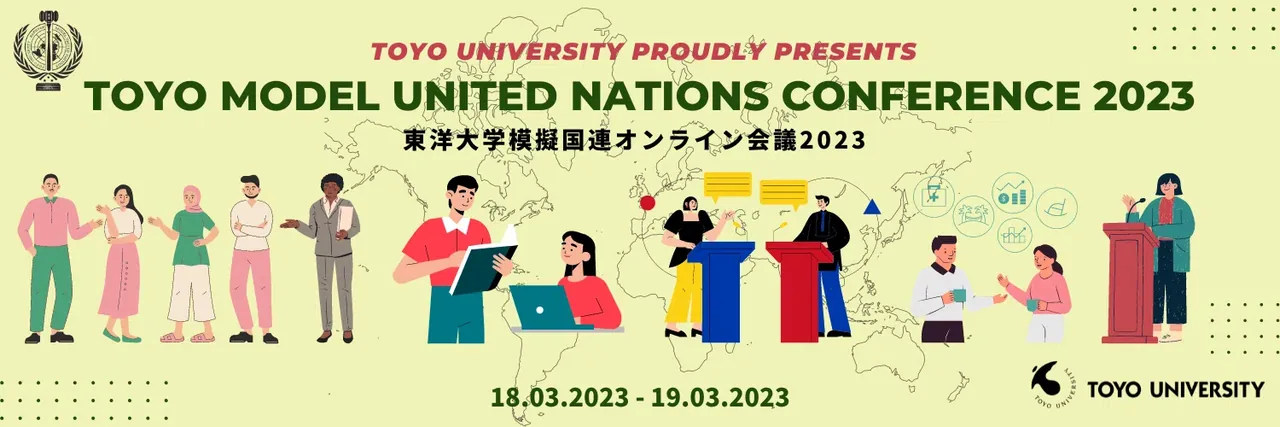
Toyo University Model United Nations

Mar 18–19, 2023 Online

Toyo University Model United Nations

Conference

Online

Mar 18–19, 2023

High school and university students

In English

Applications

Closed
Feb 9 – Mar 5, 2023
  • Delegates

About

Ensuring comprehensive sovereign state security in a globalized world.

TOYO MUN VIRTUAL CONFERENCE 4.0 ANNOUNCEMENT 

There was a lot that happened since our last conference in 2022, from political crises to record-breaking inflation. It is time to tackle global challenges together! 

We are hence very excited to announce TOYO Model United Nations Virtual Conference 2023! VERSION 4.0: 

Ensuring comprehensive sovereign state security in a globalized world. 

Toyo MUN is one of the most accessible  

conferences in Japanese Model United Nations community offered in English. Being completely free of charge, it opens numerous opportunities for participants to expand their horizons and gain meaningful connections. 

Apply here: https://forms.gle/wcB4BnwvfwT6PXbk6
 

Committees

    1. Over the last few years, global food systems have been disrupted by conflict, economic shocks, climate change, and the COVID-19 pandemic, increasing global food insecurity and malnutrition. The continuous functioning of food supply chains is essential to ensure stable and sustainable food flow for all. This can be achieved by making food supply chains more resilient. WFP delegates are challenged to suggest effective policies to ensure the governments' preparedness for unexpected supply chain disruptions. Debate can evolve to comprise food shortages in world's poorest areas instigated by the conflict in Ukraine.

    WFP

    English

    Topic

    Over the last few years, global food systems have been disrupted by conflict, economic shocks, climate change, and the COVID-19 pandemic, increasing global food insecurity and malnutrition. The continuous functioning of food supply chains is essential to ensure stable and sustainable food flow for all. This can be achieved by making food supply chains more resilient. WFP delegates are challenged to suggest effective policies to ensure the governments' preparedness for unexpected supply chain disruptions. Debate can evolve to comprise food shortages in world's poorest areas instigated by the conflict in Ukraine.

    About the committee

    The World Food Programme (WFP) is one of the world's largest humanitarian organizations created with the aim to combat hunger and contribute to restoring peace through food assistance and resilience building. A part of the United Nations (UN) framework, WFP is usually the first one on the field to provide food aid to those affected by war, civil conflict, drought, hurricanes, crop failures and natural disasters, as well as pandemics such as the global outbreak of COVID-19. At the same time, WFP keeps a sharp focus on sustainable development, providing governments with the support and skills to manage food security in the long term. The Programme was established in 1961 after the 1960 Food and Agricultural Organization (FAO) Conference, and commenced work by voluntary pledges from participating countries in the form of commodities, cash or services such as shipping. The body is governed by the WFP Executive Board, which is comprised of 36 Member States and provides intergovernmental support, direction and supervision of WFP’s activities. Those activities include but not limited to: food assistance – supplied directly to families or individuals, in kind or as cash; country capacity strengthening – by means of support for national stakeholders (whether governments or civil society) to develop and implement Zero Hunger strategies; and lastly, South-South and triangular cooperation – which is the facilitation of exchange of experience, knowledge, policy support, cash or in-kind contributions. The organization's direction is defined in its Strategic Plan, which is renewed every four years. The 2022–25 Strategic Plan expresses WFP 's commitment to the 2030 Agenda, with a focus on ceasing hunger, and supporting the United Nations' endeavors to help countries respond to the urgent needs of those furthest behind and attain the Sustainable Development Goals. Principally, WFP`s operations are funded by voluntary donations from world governments, corporations and private donors. In conclusion, the World Food Programme is dedicated to granting timely response to emergencies as well as building a long-term food security. On top of that, the organization is faced with global challenges such as climate change and raging humanitarian crises in Afghanistan, Burkina Faso, Ethiopia, South Sudan, Syria, and Ukraine.

    Countries

    1. The energy crisis triggered by the Russian invasion of Ukraine has reshuffled the immediate priorities of policymakers. Governments in Europe are striving to ensure an adequate energy supply for the winter and fund packages to aid households and businesses in coping with surging gas and electricity bills. With energy security at the top of the agenda at the start of the winter heating season, policymakers and energy officials hasten to expand renewable energy generation in pursuit of replacing part of the fossil fuel consumption and ensure energy security. The Delegates of ECOSOC are expected to explore policy options available to countries to respond to the energy price shock and supply disruptions. They are also expected to consider how energy security and climate security should go hand-in-hand, and propose actions to reduce the world's dependence on non-renewable resources.

    ECOSOC

    English

    Topic

    The energy crisis triggered by the Russian invasion of Ukraine has reshuffled the immediate priorities of policymakers. Governments in Europe are striving to ensure an adequate energy supply for the winter and fund packages to aid households and businesses in coping with surging gas and electricity bills. With energy security at the top of the agenda at the start of the winter heating season, policymakers and energy officials hasten to expand renewable energy generation in pursuit of replacing part of the fossil fuel consumption and ensure energy security. The Delegates of ECOSOC are expected to explore policy options available to countries to respond to the energy price shock and supply disruptions. They are also expected to consider how energy security and climate security should go hand-in-hand, and propose actions to reduce the world's dependence on non-renewable resources.

    About the committee

    The Economic and Social Council (ECOSOC) is one of the 6 principal organs of the United Nations (UN) framework established by the UN Charter in 1945. The body coordinates economic, social, and related work of the fourteen United Nations specialized agencies, functional commissions and five regional commissions. ECOSOC serves as the central platform for discussing international economic and social issues, and developing policy recommendations addressed to Member States and the United Nations system. ECOSOC has 54 members elected by the General Assembly (GA) for a three-year term. Every year 18 new members are elected according to a geographical distribution. ECOSOC has no permanent members, but a country can be reelected immediately. The council`s main areas of focus are: promoting higher standards of living, full employment, and economic and social progress; formulating solutions to international economic, social and health problems; fostering international cooperation in cultural and educational domain; and advocating for universal human rights and fundamental freedoms. ECOSOC meets in annual sessions (see chap. 6), running from July to July. ECOSOC`s activities are subsidized through the UN budget adopted by the General Assembly. To conclude, there are a variety of activities in the socio-economic sphere that ECOSOC is concerned with. The current challenges to the body are, among others, extreme poverty, inequalities within and among countries as well as other issues associated with weak governance, natural disasters, environmental degradation, unsustainable consumption and production patterns, climate change and a volatile global financial system.

    Countries

    How this committee type works

More MUN conferences

ConferencesOnlineTOYO MUN 2023