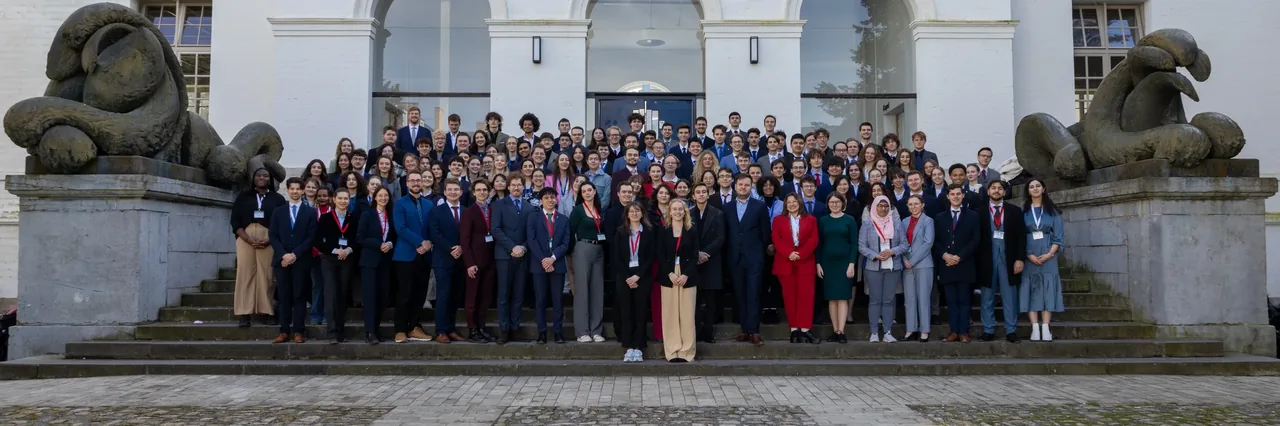
KULMUN 2025

KU Leuven Model United Nations

Mar 4–8, 2025 Leuven, Belgium

KU Leuven Model United Nations

Conference

Leuven, Belgium·Europe

Mar 4–8, 2025

140 delegates expected

University students

In English

How it went

4.219 ratings from delegates
Academics
4.67
Logistics
3.89
Socials
4.11

About

Decentering the Narrative: A Pathway for International Cooperation and Partnerships in the Periphery

Join us to celebrate the 15th edition of the annual KULMUN conference!  

The KU Leuven Model United Nations Association (KULMUN) is a student-run organization with a passion for debate, international politics, and connecting with persons of diverse opinions. As well as this, we host Belgium's finest annual Model United Nations Conference known for its outstanding academics and fun social activities in the beautiful hidden gem of Belgium; the city of Leuven.

It’s with a lot of excitement and pride that we therefore introduce our 2025 theme: Decentering the Narrative: A Pathway for International Cooperation and Partnerships in the Periphery

The international development agenda has greatly evolved since the start of the century. Nonetheless, the twenty-first century has given rise to new challenges and priorities, particularly in the form of the climate crisis, inequality, and the rise of international terrorism. This can lead to those living in the global periphery, away from international markets and major decision-making centers feeling disconnected from the agenda that concerns them.

The agenda is shifting, though. The transition from the Millennium Development Goals to the Sustainable Development Goals especially highlights how the international community is beginning to recognize that there is a degree of variability in the challenges each country, and region, faces. Thus, it is becoming clear that in order to achieve the development and security goals sought after by the international community, it is time to decenter the narrative from Western-centric ideas of how development should occur. This advances an international agenda that accurately recognizes the cultural, political, and economic pluralism of our world.

Delegate Applications have opened; apply here: https://form.typeform.com/to/hjWcf3bE?typeform-source=www.kulmun.be

We look forward to welcoming you to Leuven!

Committees

    1. Echoes of the Past: Repatriating Cultural Artifacts
    2. Shields of Learning: Ensuring Safe Acces to Education Amidst Conflict
    • Sophia Pizano Sanchez
    • Fatama Jabin

    UNESCO

    Beginner · English

    Topics

    1. Echoes of the Past: Repatriating Cultural Artifacts
    2. Shields of Learning: Ensuring Safe Acces to Education Amidst Conflict

    About the committee

    The United Nations Educational, Scientific and Cultural Organization (UNESCO) was founded on November 16, 1945, to promote peace and security through international collaboration in education, science, culture, and communication. It aims to build intercultural understanding, protect heritage, and support scientific advancements. UNESCO’s work includes designating World Heritage sites, promoting literacy and gender equality in education, enabling freedom of expression, and coordinating international cooperation on environmental issues. By encouraging the free exchange of ideas and knowledge, UNESCO strives to cultivate a more inclusive, equitable, and sustainable world.

    Chairs

    Countries

    How this committee type works
    1. Giving Europe a Home: Adressing the Housing Crisis in the European Union
    2. Setting the Foundations for a Globally-reaching Europe: Examining the European Union's Foreign Policy Through Reform of the Treaty on the Functioning of the European Union

    • Miha Persyn
    • Stepan Kunevich

    European Parliament

    Intermediate · English

    Topics

    1. Giving Europe a Home: Adressing the Housing Crisis in the European Union
    2. Setting the Foundations for a Globally-reaching Europe: Examining the European Union's Foreign Policy Through Reform of the Treaty on the Functioning of the European Union

    About the committee

    The European Parliament, the sole directly elected institution within the European Union, plays a pivotal role across all areas of EU competence and serves as a vital driving force behind European integration. Comprising 720 representatives organized by political affiliation rather than nationality, its primary function is to adopt European legislation proposed by the European Commission and to act as an equal co-legislator alongside the Council of the European Union. Through its extensive legislative, budgetary, and supervisory powers, the European Parliament stands as a true representative of the people, for the people.

    Chairs

    Countries

    1. Eco-Production: Combatting Greenwashing while Promoting Sustainable Manufacturing and Green Product Design
    2. Climate Adaptation: Building Resilient Infrastructure to Combat Extreme Weather Events
    • Adriana Lucero-Dorst

    UNEP

    Beginner · English

    Topics

    1. Eco-Production: Combatting Greenwashing while Promoting Sustainable Manufacturing and Green Product Design
    2. Climate Adaptation: Building Resilient Infrastructure to Combat Extreme Weather Events

    About the committee

    The United Nations Environment Programme (UNEP) is an international organization established in 1972 to coordinate the global environmental agenda. Headquartered in Nairobi, Kenya, UNEP works to promote sustainable development and environmental conservation through research, advocacy, and partnerships. UNEP’s work is focused on helping countries transition to low-carbon and resource-efficient economies, strengthening environmental governance and law, safeguarding ecosystems, and providing evidence-based data to inform policy decisions. Its initiatives address critical issues such as climate change, biodiversity loss, pollution, and resource management, aiming to protect and restore the planet for present and future generations

    Chair

    Countries

    How this committee type works
    1. Rethinking NATO's Role in Counterterrorism: Embracing Inclusive Approaches in Peripheral Regions
    2. Preserving Common Values: A United Front Towards Political Challenges
    • Marelaine Formosa
    • Dominik Palkovič

    NATO

    Intermediate · English

    Topics

    1. Rethinking NATO's Role in Counterterrorism: Embracing Inclusive Approaches in Peripheral Regions
    2. Preserving Common Values: A United Front Towards Political Challenges

    About the committee

    The North Atlantic Treaty Organization (NATO) is a political and military alliance established in 1949. Comprising 32 member countries from North America and Europe, NATO's primary mission is to ensure the collective defense of its members against aggression. This is achieved through mutual defense agreements, whereby an attack on one member is considered an attack on all. NATO’s core mandates encompass deterrence and defense, crisis prevention and management, and cooperative security. The organization engages in various activities including military operations, peacekeeping missions, and crisis management. Additionally, it promotes democratic values and encourages cooperation on defense and security-related issues among its members and partner nations.

    Chairs

    Countries

    How this committee type works
    1. Fostering Sustainable Development by Adressing Irregular Settlements in Latin America
    2. Completing the Energy Transition: The 2030 Agenda, Public and Private Investment and Infrastructure
    • Marián Palacios Fernández
    • Jáchym Šetka

    ECLAC

    Expert · English

    Topics

    1. Fostering Sustainable Development by Adressing Irregular Settlements in Latin America
    2. Completing the Energy Transition: The 2030 Agenda, Public and Private Investment and Infrastructure

    About the committee

    The Economic Commission for Latin America and the Caribbean (ECLAC) is a regional commission of the United Nations, established in 1948. ECLAC's primary mission is to promote economic and social development in Latin America and the Caribbean through research, policy advice, and technical assistance. It conducts in-depth analyses of economic trends, social issues, and sustainable development challenges. Furthermore, ECLAC facilitates regional cooperation and integration, providing a forum for dialogue among member states. By offering data, policy recommendations, and support, ECLAC aims to enhance equitable growth, reduce inequality, and improve living standards across the region.

    Chairs

    Countries

    1. Crucible of the Caribbean: Cuba's Internal Struggle for Unity in the Face of the 1962 Missile Crisis
    • Ana Domínguez Rodríguez
    • Paula Romo Barthe
    • Yoana Nikolova
    • Mert Çelik
    • Matilde Minto
    • Tomás Branco

    Crisis

    Expert · English

    Topic

    Crucible of the Caribbean: Cuba's Internal Struggle for Unity in the Face of the 1962 Missile Crisis

    About the committee

    Crisis is a committee in which a delegate represents a character from a country or the country itself. It simulates a real-life crisis situation, often based on reality, that the delegates need to try and resolve. It is a highly interactive committee in which each delegate can have an impact on the outcome and each decision can lead to unprecedented events.

    Chairs

    Countries

    How this committee type works
  • No Conference is complete without a team of journalists who report on the happenings of the conference. For this, we have our very own media outlet, the Newswire. The Newswire, consisting of an Editor-In-Chief and journalists, will not only be in charge of delivering articles about the intriguing debates in committee but will also be responsible for all other forms of social media such as the KULMUN Newswire Instagram account. If you’d like to improve your writing and reporting skills then this is the perfect committee for you!
    • Maurice de Jong

    Newswire

    Expert · English

    About the committee

    No Conference is complete without a team of journalists who report on the happenings of the conference. For this, we have our very own media outlet, the Newswire. The Newswire, consisting of an Editor-In-Chief and journalists, will not only be in charge of delivering articles about the intriguing debates in committee but will also be responsible for all other forms of social media such as the KULMUN Newswire Instagram account. If you’d like to improve your writing and reporting skills then this is the perfect committee for you!

    Chair

    Countries

    How this committee type works

Past editions

  • 4editions since 2016
  • 4.21 average of 9 ratings

Partner conferences
MUNUSAL 2024
Salamanca, Spain

View conference
JCUMUN 2024

Rome, Italy

View conference
BIMUN/SINUB 2023

Bonn, Germany

View conference
EuroMUN 2024

Maastricht, Netherlands

View conference
Salient 2024

Ljubljana, Slovenia

View conference
TEIMUN 2024

The Hague, Netherlands

View conference
PragueMUN 2025

Prague, Czech Republic

View conference

Organizers

Alex Koval
Deputy Secretary General
Christine Langman
Deputy Secretary General
Daniel Kahn Sasso
Secretary General
Jasper Kochuyt
Conference Manager
Kulmun Board
Organiser

Marie Lowette
Vice-Conference Manager

More MUN conferences

ConferencesBelgiumKULMUN 2025