JMMUN 2025

Japan Metropolitan Model United Nations

Mar 29–30, 2025 Kanagawa, Japan

Japan Metropolitan Model United Nations

Conference

Kanagawa, Japan·Asia

Mar 29–30, 2025

400 delegates expected

High school students

In English

How it went

4.2772 ratings from delegates
Academics
4.19
Logistics
4.31
Socials
4.32

About

Harmony: Taking Down Barriers of Prejudice and Misconception

Welcome to Japan Metropolitan Model United Nations 2025!

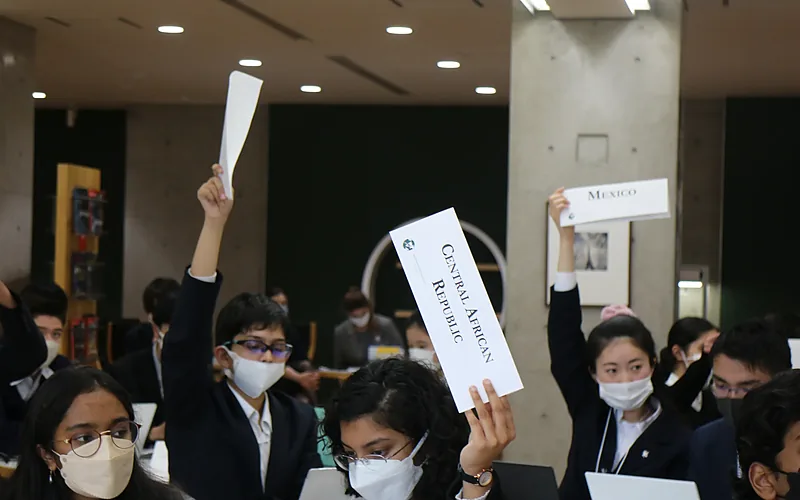
JMMUN is an all‐English Model United Nations conference held annually in March at Senzoku Gakuen High School located in Kanagawa, Japan, organized entirely by junior and senior high school students. For ten years, JMMUN has continued to grow, expanding to host over 30 schools and more than 400 delegates from within Japan and countries abroad.

With committees divided by levels based on MUN experience and English abilities, JMMUN allows delegates to participate comfortably in committees at the level of their choice, while also providing an opportunity for them to challenge themselves with a high-level committee. At JMMUN 2025, there will be two Beginner committees, two Intermediate committees, and one Advanced committee, all of which will be held in UNA‐USA style.

Regarding these committee levels, please reference the following criteria:
Beginner: Students who have little MUN experience and/or are unsure of their English abilities
Intermediate: Students who have experience in MUN and/or have an English speaking ability above daily conversation
Advanced: Students who have participated in competitive MUN conferences and/or are able to discuss in English on an academic level

Delegates can apply as either a double or a single delegate. Furthermore, please note that the country preferences and committee preferences may not be reflected depending on the availability. However, preferences on committee level will be reflected.

The staff are delighted to welcome you to the conference, and we look forward to seeing you in March!

Committees

  • 87 countries
    1. Securing Children's Access to Education

    United Nations International Childrens Emergency Fund - UNICEF

    Beginner · English · 87 countries

    Topic

    Securing Children's Access to Education

    About the committee

    The United Nations International Children’s Emergency Fund was established in 1946 in the aftermath of World War II. It is dedicated to helping children and young people whose lives and futures are at risk. UNICEF has reached every child in need, protecting children’s rights to survive, thrive, and reach their full potential, and has consistently worked to protect the rights and wellbeing of all children and young people. Economic factors such as child labor and poverty and cultural factors such as gender, ethnicity, and religion make it difficult for many children to go to school. Therefore, in order to ensure children's access to education, it is important to take action to eliminate challenges caused by cultural reasons, economic reasons, natural disasters, and pandemics.

    Countries

    How this committee type works
  • 52 countries
    1. Protecting the Human Body from Harmful Environmental Pollution

    United Nations Environment Programme - UNEP

    Beginner · English · 52 countries

    Topic

    Protecting the Human Body from Harmful Environmental Pollution

    About the committee

    The United Nations Environment Programme (UNEP) was founded in 1972 after the UN Conference on the Human Environment and was established to monitor the state of the environment on a global scale. UNEP has also worked closely with the UN’s 193 member states to implement worldwide commitments and coordinate responses to the world’s environmental challenges. As economic development and urbanization continue to pollute the Earth's environment that all humans are inevitably exposed to, environmental pollution is an issue that must be addressed immediately because of the various negative effects that it has on the human body.

    Countries

    How this committee type works
  • 84 countries
    1. Equal Opportunities for Women in the Workforce

    International Labour Organization - ILO

    Intermediate · English · 84 countries

    Topic

    Equal Opportunities for Women in the Workforce

    About the committee

    The Constitution of the ILO (International Labour Organization) was drafted in 1919 by the Labour Commission. ILO has played a role at key historical junctures – the Great Depression, decolonization, and the victory over apartheid in South Africa – and today strives to create a moral and effective structure that ensures equitable globalization. This committee is dedicated to promoting rights at work, encouraging decent employment opportunities, enhancing social protection and strengthening discussions regarding work-related issues. In a world where societal standards are rapidly evolving, ensuring female rights in the workforce requires global attention in order for an increase in work efficiency, economic growth balanced with the protection of female workers, and innovation.

    Countries

  • 54 countries
    1. Ethical Considerations in the Promotion and Usage of AI

    Commission on Science and Technology for Development - CSTD

    Intermediate · English · 54 countries

    Topic

    Ethical Considerations in the Promotion and Usage of AI

    About the committee

    The United Nations Commission on Science and Technology for Development is a subsidiary body of the United Nations Economic and Social Council, and was created in 1979, first held in Vienna. The platform is currently composed of 43 nations and holds an annual intergovernmental forum for discussion on timely and pertinent issues concerning science, technology, and development. This committee was created to provide the United Nations with high-level advice through analysis and policy recommendations to guide the future work of the United Nations, develop common policies and agree on appropriate actions. It also ensures that developing countries and its citizens do not get left behind. Development and innovation in AI can open up new opportunities in various areas; however, on the other hand, AI-systems are likely to deliver biased results and can have harmful effects. Therefore, careful consideration of the benefits and consequences of the promotion and usage of AI is necessary in order to facilitate safe innovation.

    Countries

    How this committee type works
  • 31 countries
    1. Tackling Economic Disparities Caused by Racial and Sexual Differences
    United Nations Development Programme - UNDP

    Expert · English · 31 countries

    Topic

    Tackling Economic Disparities Caused by Racial and Sexual Differences
    About the committee

    The United Nations Development Programme (UNDP) was established in 1966 by combining the United Nations Expanded Programme of Technical Assistance and the United Nations Special Fund. Currently, it is working in 170 countries and territories to eradicate poverty and reduce inequality. This committee helps countries develop policies, leadership skills, partnerships, and institutional capabilities to achieve the Sustainable Development Goals. Traditional biases and discrimination impact aspects like employment, income, and jobs, thus causing economic disparities. To tackle this problem, it is crucial to understand each other’s situations and implement policies that are inclusive to everyone. By supporting underrepresented communities and celebrating diversity, we hope to build a society where everybody has a fair opportunity to succeed.

    Countries

    How this committee type works

Organizers

More MUN conferences

ConferencesJapanJMMUN 2025