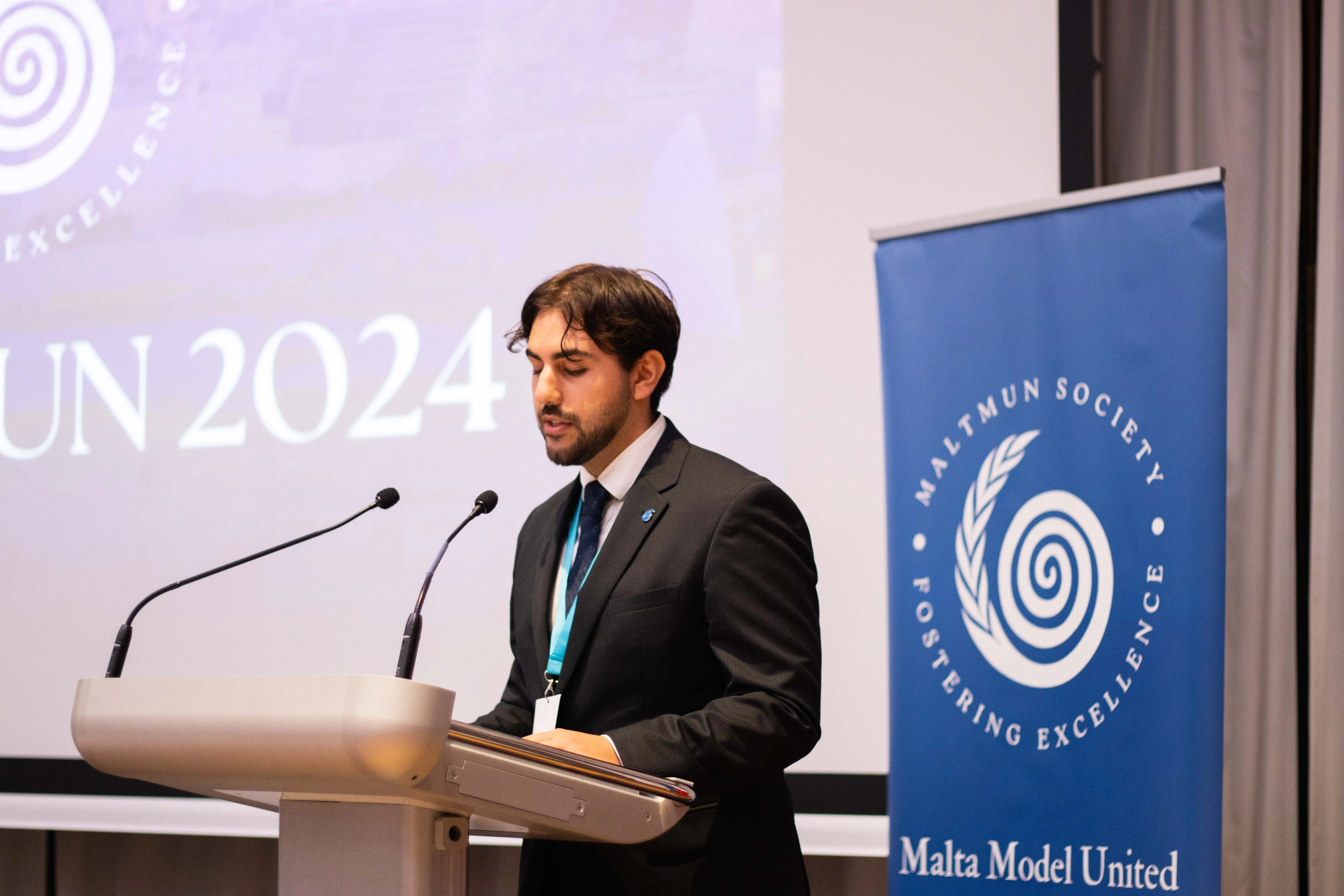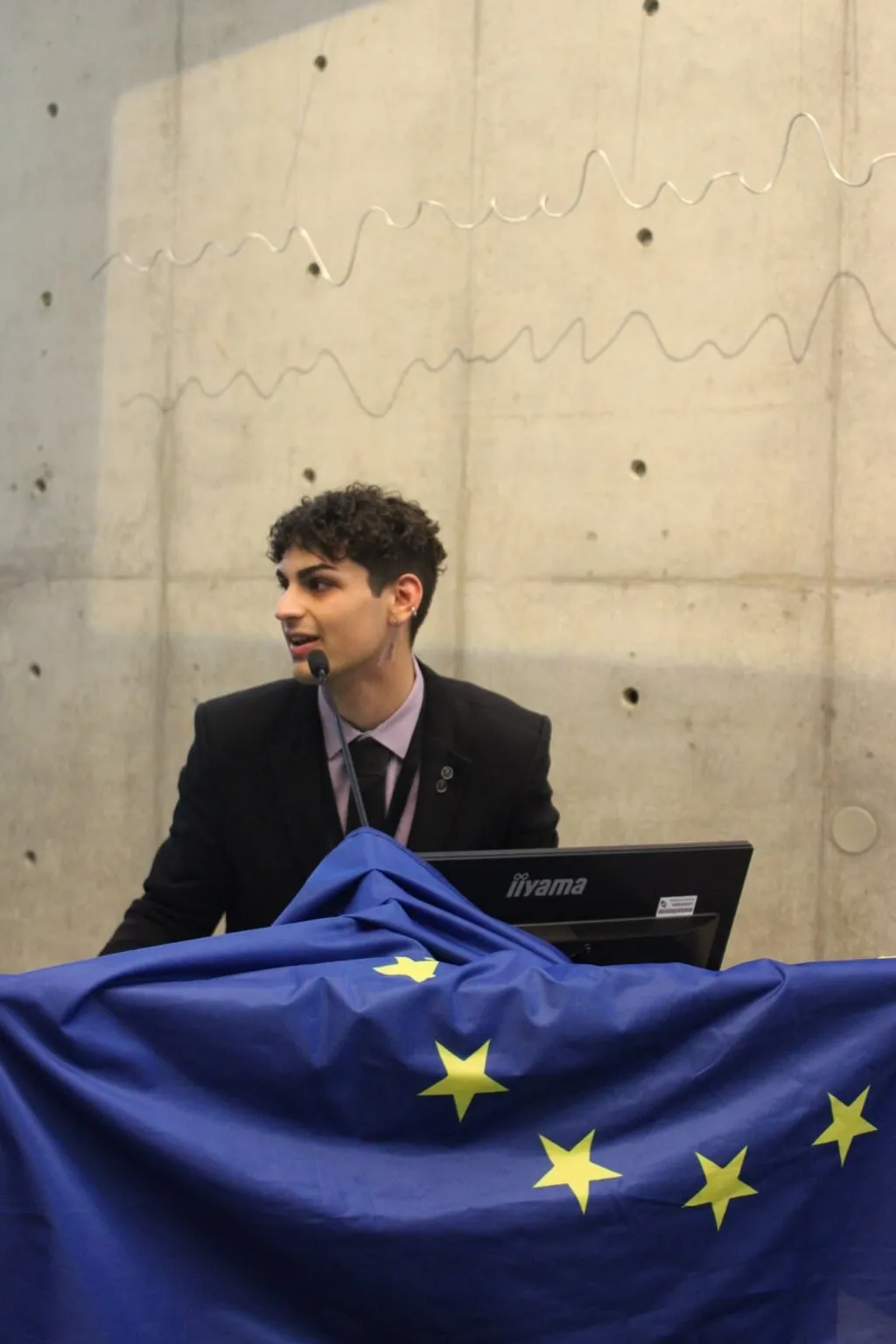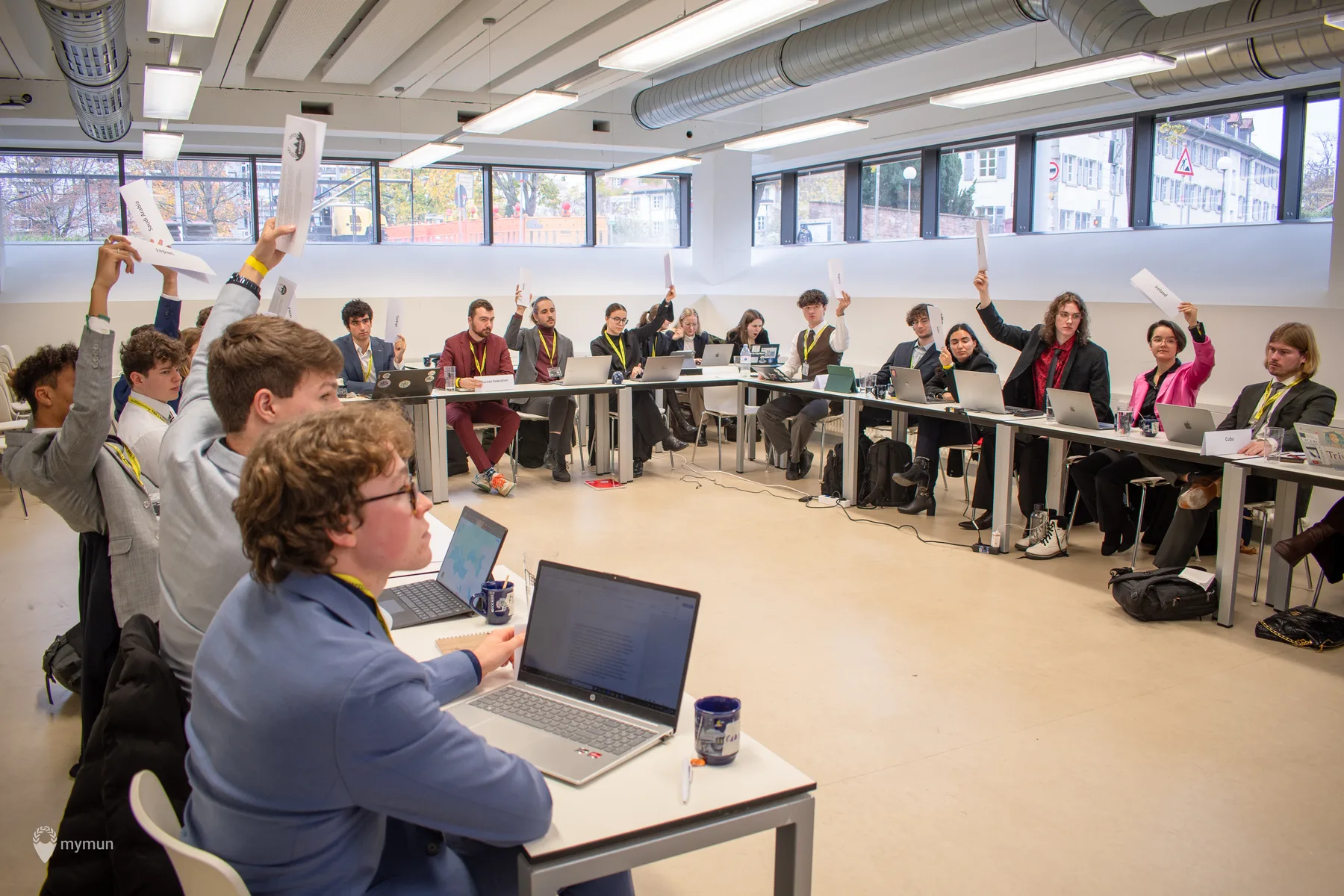
Picture a room full of teenagers in suits, name placards in front of them, each one speaking not for themselves but for a nation. One represents Brazil, another Japan, another a country they'd struggled to find on a map a month ago. For two or three days, they argue, negotiate, scribble notes across the room, form alliances, watch those alliances fall apart, and try, genuinely try, to solve a problem that the real world hasn't managed to solve yet: a refugee crisis, a pandemic, a war.
Nobody makes them do this. They give up their weekends for it. They get nervous before speeches and replay them afterwards. And a surprising number of them walk out changed: more confident, more curious about the world, more willing to stand up and say what they think.
That's the part worth understanding first. Before the rules and the acronyms, Model UN exists to do something simple and quietly powerful. It puts a young person in someone else's shoes, hands them a real-world problem, and asks them to lead. The diplomacy is the lesson. Everything else is just how it's delivered.
So, what does MUN stand for?
MUN stands for Model United Nations. It's an educational simulation in which students take on the roles of delegates representing different countries and debate real global issues, following the same kinds of rules and procedures the actual United Nations uses.
Think of it as the United Nations, rehearsed by students. You're assigned a country to represent (not your own) and a committee to sit in, such as the General Assembly, the Security Council, or a specialised body on health, human rights, or the environment. Your job is to research your country's real position, defend it persuasively, work with other delegates to write solutions, and ultimately pass a resolution the room can agree on.
It runs everywhere: in school clubs, at university societies, and at conferences that range from a single afternoon in a classroom to week-long international events with thousands of participants.
What actually happens at a MUN conference?
A conference is built around committees. Each committee is a group of delegates, anywhere from twenty to a few hundred, all debating the same topic, like "the global response to climate migration" or "nuclear non-proliferation."
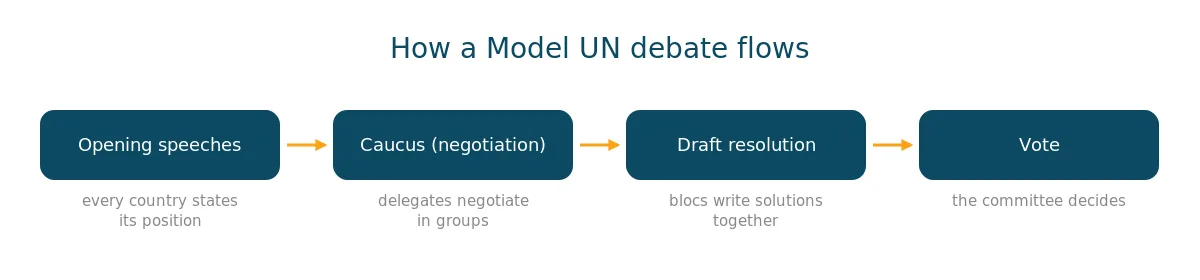
A typical session looks like this. The committee opens, delegates give short opening speeches laying out where their country stands, and then the real work begins: hours of structured debate broken up by negotiation, as blocs of like-minded countries huddle together to draft proposals. Those proposals get refined, amended, argued over, and finally voted on. If a resolution passes, the committee has, in its small simulated way, reached the kind of agreement that diplomacy is all about.
Overseeing it all is the chair, who runs the debate, keeps order, and scores delegates on how well they argue, collaborate, and stay true to their country's position. At competitive conferences, the strongest delegates earn awards, but ask most veterans and they'll tell you the awards were never really the point.
What kinds of committees are there?
Not every committee feels the same, and the one you're placed in shapes your whole experience. Most fall into a few familiar families.
- The General Assembly (GA) is the largest and the friendliest place to start. Topics are broad, the committees are big, and the pace is forgiving, which makes it ideal for a first conference.
- The Security Council is small, fast, and high-stakes. With only fifteen members and the five permanent powers holding a veto, every word carries weight.
- ECOSOC and the specialised agencies zoom in on a single area, simulating bodies like the World Health Organization, UNESCO, or the Human Rights Council. If you care about a specific issue, this is where you'll find it.
- Regional and historical committees narrow the lens further, recreating bodies like the European Union or the African Union, or setting the debate at a particular moment in history.
- Crisis committees are the wild card: small, unpredictable, and driven by live updates that can upend the room in minutes. They're a thrill, though usually not where most people begin. (We break them down in our guide to MUN crisis committees.)
As a beginner, you'll almost always start in a General Assembly committee, which is exactly where you want to be while you find your feet.
Who's who: the key roles
Model UN has a small cast of characters, and knowing them makes everything else easier to follow.
- Delegates are the students representing countries. This is where almost everyone starts. You research, speak, negotiate, and write.
- Chairs run a committee. They moderate debate, enforce the rules, answer questions, and evaluate delegates. Many chairs are experienced delegates stepping up, and if you stick with MUN, chairing is often the natural next step. (We wrote a whole guide on how to be a good chair.)
- The secretariat is the team that organises the conference itself: the secretary-general and their directors, who handle everything from committee topics to logistics.
You don't need to worry about most of this on day one. You'll be a delegate, and a delegate's world is refreshingly simple: know your country, make your case, find your allies.
How a debate actually works
The procedure can look intimidating from the outside. There's jargon, there are motions, there's a rhythm you don't yet know. But underneath it, a MUN debate is just a structured conversation, and it moves between two modes.
The first is formal debate, often called the General Speakers' List, where delegates take turns giving short speeches to the whole committee. The second is caucusing, the more informal, fast-moving negotiation where the actual deal-making happens. Delegates leave their seats, cluster into groups, and hammer out the language of a resolution together.
A resolution is the document the committee is working towards: a formal, structured proposal that lays out the problem and the solutions the delegates have agreed on. Writing one is a craft of its own, and it's where research, persuasion, and teamwork all come together.
If you'd like the mechanics in detail, our guide to the rules of procedure in Model UN breaks down exactly how the formal side works. For your first conference, though, just hold on to the big idea: speeches to persuade the room, caucuses to build the deal, a resolution to seal it.
Why students get hooked on MUN
Here's the strange thing about Model UN: people come for the debate and stay for everything around it.
They stay because MUN quietly teaches the skills that school rarely makes room for: public speaking, persuasive writing, thinking on your feet, finding common ground with people who disagree with you. They stay because researching a country you've never been to has a way of making the whole world feel closer and more urgent. And they stay, honestly, for the people. The friendships that form over late-night resolution drafting and conference socials tend to outlast the conferences themselves.
It's also genuinely useful down the line. The confidence to speak up, the habit of seeing an argument from the other side, the ability to write clearly under pressure: none of these expire when the conference ends. Plenty of MUNers will tell you it shaped what they studied, where they worked, and how they carry themselves in a room.
Common questions about Model UN
A few questions come up again and again from people about to try MUN for the first time.
Do I need any experience to start? No. Almost everyone starts with zero experience, and conferences are full of first-timers. Most beginners are placed in General Assembly committees precisely because they're the gentlest place to learn.
Is Model UN hard? It can feel intimidating before your first session, mostly because of the unfamiliar procedure and the nerves of public speaking. But the core skills are learnable, and a few hours in, the rhythm starts to make sense. Preparation is the great equaliser: a delegate who has done their research almost always feels more in control.
How long is a MUN conference? Anywhere from a single afternoon at a school event to a full week at a large international one. Most weekend conferences run two to three days.
What do you wear to a MUN conference? Western business attire is the standard: a suit, or a blazer with smart trousers or a skirt. Looking the part is part of stepping into the role of a diplomat.
What is a position paper? A position paper is a short document, usually a page, that summarises your country's stance on the committee's topics before the conference begins. It's the single most useful piece of preparation you can do, and we have a full guide on how to write a position paper.
Can you win at Model UN? Many conferences hand out awards like Best Delegate, but the scoring rewards far more than just talking the most. Chairs look for research, diplomacy, collaboration, and staying true to your country's position. Plenty of experienced MUNers will tell you the friendships and the growth mattered more than any gavel.
How is MUN different from a debate club? Debate is usually about winning an argument for your own side. Model UN is about diplomacy: you represent a country's interests, but the goal is to build a coalition and pass a resolution the room can agree on. It rewards persuasion and compromise in equal measure.
How to start your MUN journey
The good news is that Model UN is one of the easiest worlds to step into. You don't need experience, connections, or a perfect first speech. You just need a conference to go to.
That's where mymun comes in. You can browse Model UN conferences happening around the world and find one near you (or one worth travelling for), see what committees and topics they're running, and apply, all in one place. Once you're in, mymun and MUN Command are also where a lot of the behind-the-scenes work happens, from managing your delegation to organising your conference experience.
And once you've found your conference, don't walk in cold. Our complete beginner's guide to your first MUN walks you through everything that comes next: how to prepare, what to expect on the day, and how to make your first conference a great one.
Model UN started, for almost everyone who loves it, with a single nervous "yes." This is yours.