Conference
Online
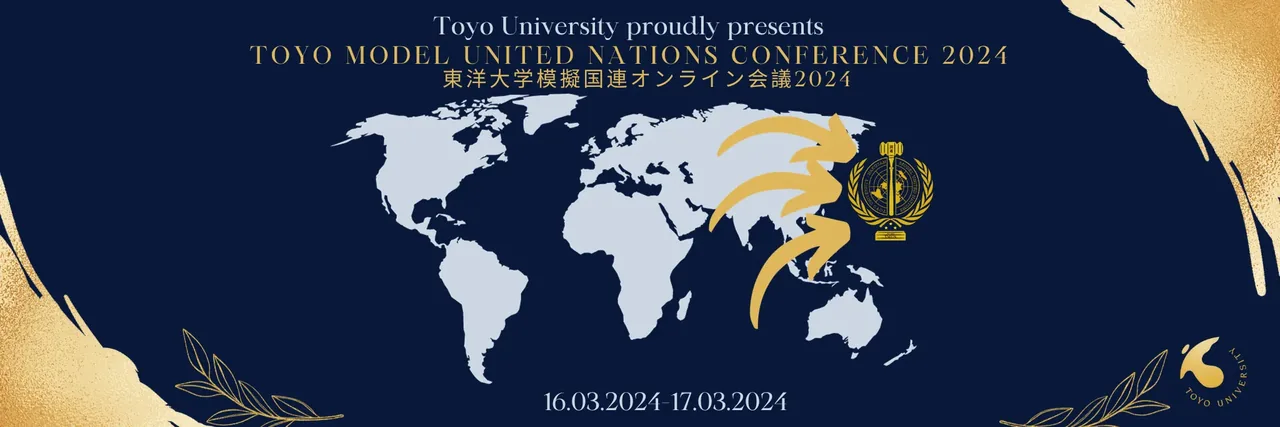
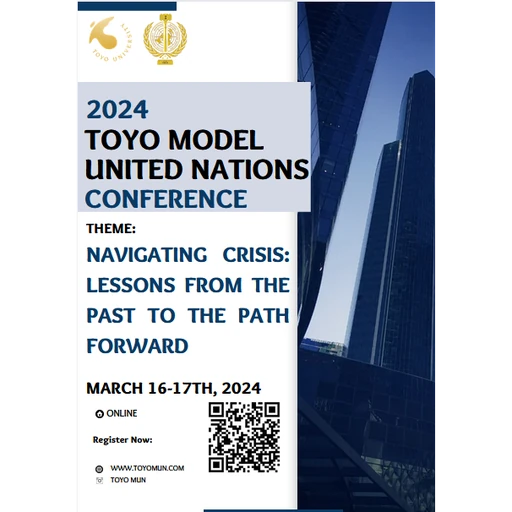
Mar 16–17, 2024
High school and university students
In English
Applications
Closed- Delegates
About
Navigating Crisis: Lessons from the Past for the Path Forward.
Warm greetings from the Toyo Model United Nations (TOYO MUN)!
We would like to invite you to the TOYO MUN Virtual Conference (TMUNVC) 5.0 held this March 16-17, 2024 at Toyo University, Tokyo, Japan.
TOYO MUN conference seeks to provide unique opportunities to practice international relationships, law, politics, and economics internationally. Having a cosmopolitan academic environment here at Toyo University, we view the upcoming conferences as an opportunity to connect students from a range of cross-cultural backgrounds together. Our team sincerely hopes that these dynamic, informative debates will not only serve academic and idea-exchanging purposes but also serve as a platform for delegates to form meaningful connections and friendships. Therefore, we sincerely hope to partner with your university by welcoming delegates and members of the audience.
This year our conference will be held online through Zoom in English. At Toyo MUN 2024, delegates will be prompted to turn to successfully resolve past crises and pave the path for problems of the new generation. Hence our theme: “Navigating Crisis: Lessons from the Past for the Path Forward.”
There would be 3 committees:
1) UNICEF (Beginner)- Tackling the Crisis of Child Labour Worldwide
2) WTO (Intermediate) - Strengthening Fair Practices in International Trade
3) Crisis Committee (Advanced) - Simulation of the Suez Crisis
The delegate application is already open until March 5, 2024. The conference is also open to the public. You can directly apply from the following form: https://docs.google.com/forms/d/1nJCqILKNgpJxMdGwbUVSnhCQQdNxXToPd08QTgPLRUI/prefill
You can also refer to our website for more information: https://www.toyomun.com/
We are looking for your applications.
All the best and kind regards,
TOYO MUN 5.0 Organizing Committee
Committees
UNITED NATIONS CHILDREN'S FUND (UNICEF) ABOUT THE UN Children's Fund (BEGINNER) The United Nations Children’s Fund (UNICEF) was established in 1946 in response to famine and disease affecting children in Europe. The mission of UNICEF at the time was to provide the affected children with food, healthcare, and clothing. In 1953, the UN General Assembly established UNICEF as a permanent organ of the UN. The committee’s early projects encompassed campaigns to fight and eliminate treatable mass diseases of the day such as tuberculosis, yaws, and leprosy. After the GA passed the Declaration of the Rights of the Child in 1959, UNICEF had an official UN document around which to frame its goals. In 1961, UNICEF expanded its goals beyond improving children’s health and nutrition to also include education. Around this time, the committee also developed its modern theory on aid, which promotes a holistic approach to addressing the needs of children. Tackling the Child Labor Worldwide During TOYO MUN 2024, UNICEF council will attempt to address the issue of Child Labor worldwide. Although some progress has been made in this sphere, there are huge gaps around the world in this area. The United Nations in general, and UNICEF in particular, is well suited to spearhead the charge to improve respect for the rights of children and their standards of living. We especially encourage beginner delegates to try their hand at this council to practice their public speaking and debate skills.
ABOUT WORLD TRADE ORGANIZATION (INTERMEDIATE) The World Trade Organization (WTO) is a global intergovernmental institution situated in Geneva, Switzerland, responsible for regulating international trade relations among nations. Its foundation lies in the WTO agreements, initially drafted by its founding members and endorsed by the world's major trading nations. Operating on the principles of non-discriminatory, transparent, and environmentally protective trade, the WTO strives for fair competition and inclusivity, particularly supporting less developed countries. The WTO emerged in 1995, succeeding the General Agreement on Tariffs and Trade (GATT), which had been the primary facilitator of global trade from 1948 to 1994. The transition occurred in response to the need for a more structured international body, and foundational agreements were established during the Uruguay Round negotiations in the mid-1980s. The WTO officially came into existence on January 1, 1995. Distinguishing itself from the GATT, the WTO expands its scope to include not only the trading of goods but also services and intellectual property. Additionally, in terms of legal matters, the WTO introduced enhanced mechanisms for dispute resolution. By 2013, the WTO boasted the membership of 159 countries, a number that increased to 164 in 2019, encompassing 98 percent of global trade. STRENGTHENING FAIR TRADE PRACTICES At TOYO MUN 2024, the delegates of WTO will be prompted to come up with ideas to Strengthen Fair Practices in International Trade. Fair Trade is a trading partnership, based on dialogue, transparency and respect, that seeks greater equity in international trade. It contributes to sustainable development by offering better trading conditions to, and securing the rights of, marginalized producers and workers – especially in the South. Delegates are urged to refer to the background guide for more in-depth information on this specified topic. Background guide to be published soon.
ABOUT THE CRISIS COMMITTEE (ADVANCED) What is a Crisis Committee? A crisis committee is a decision-making body that has more power than conventional committees. While the General Assembly committees can only recommend and build consensus around the existing situation, the Crisis council creates the situation in live mode. Examples of groups that can be simulated in the Crisis council include a Cabinet, a Royal Court, or just any group that possesses political power. Crisis committee is more dynamic and fast-paced than usual committees, so every delegate is very influential. In your preparation, it is useful to understand the committee’s basic history and scope of power, as found in the background guide. A crisis committee covers a few years of history over the course of the weekend. Crisis committees usually take place during a critical point in history. Typically the committee begins similarly to what happened in real life, but as delegates adopt new paths, the world spins into alternate realities. Focus on making history how you see fit. Your general goal for the weekend should be to change the world to fit your agenda. This can be done in a number of ways. Frontroom directives depend on the entire committee, and effect stable, long-lasting change. You can also independently create change on a smaller scale by using personal powers, done through note writing. Over time, personal powers can grow and become as influential as the directives from the committee. At TOYO MUN 2024, Delegates are invited to develop a scenario on the basis of the Suez Crisis of 1954.
Organizers
More MUN conferences
OnlineOnline MUN conferences March 2024MUN conferences in March 2024 High school MUNMUN conferences for high school students University MUNMUN conferences for university students
ConferencesOnlineTOYO MUN 2024