
Conference
About
“Never settle for mediocrity”
There is nothing as important to us as the individual experience of a delegate. That is why our conference emphasizes the constant need for innovations the MUN community has yet to witness.
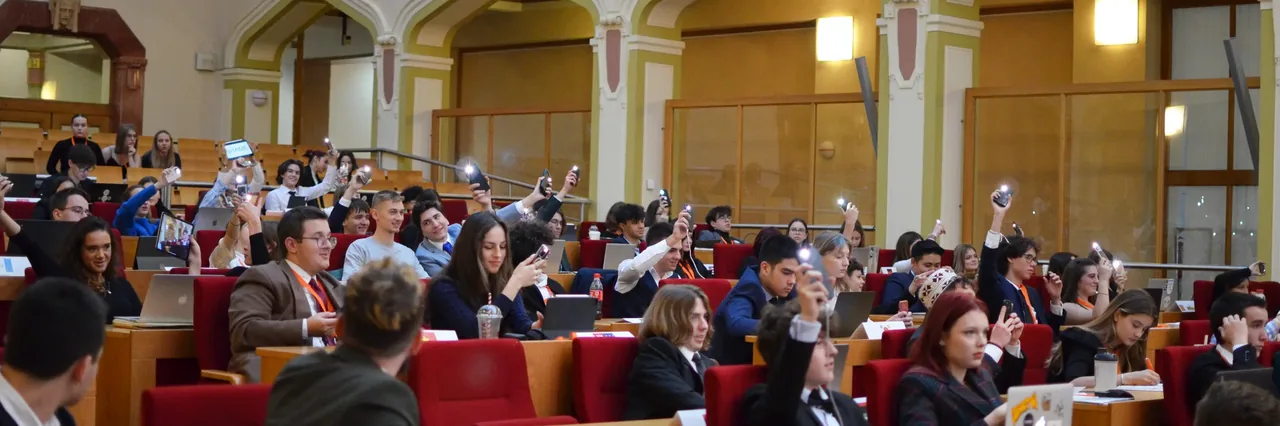
Gymnázium Omská Model United Nations is a MUN located in the beautiful historical city of Prague, named after the organising school. It is a fully student-led educational event, designed to engage students in international politics. With GOMUN’24 being the 8th annual edition of our conference, we aim to continue this long-lasting legacy to provide an experience distinctive from any previous MUN. Our conference offers a friendly environment in which each delegate participates in a debate shaped by challenging topics and innovative ideas while being entertained by occasional “fun” punishments and other amusing activities. We present the notorious social event - the Sunday Ball, the General Assembly where all delegates gather to discuss the documents they have worked on during the Committee Sessions or the mysterious Crisis Committee.
Throughout the conference, we aspire to nurture critical thinking, receptive and ambitious young people prepared to emerge as future leaders.
If you are interested, the registrations open on the 3rd of April here: https://gomun.cz
We look forward to welcoming you in Prague!
Committees
The Human Rights Council concerns itself with the violations of basic human rights, as defined by The Universal Declaration of Human Rights, around the Earth. It is one of the General Assembly committees but it also has an indirect influence on the Security Council as it often resolves the same conflicts.
The Special Political and Decolonisation Committee is among the General Assembly committees. It primarily focuses on political disputes and less serious conflicts, however, it can also tackle issues otherwise reserved for the Security Council. It can also act, as it is the case on this year’s GOMUN, as a forum for parties to an international treaty to resolve their misunderstandings outside of the General Assembly and yet within the United Nations.
The Economic and Social Council is at the heart of the United Nations system to advance the three dimensions of sustainable development – economic, social and environmental. It is the central platform for fostering debate and innovative thinking, forging consensus on ways forward, and coordinating efforts to achieve internationally agreed goals. It is also responsible for the follow-up to major UN conferences and summits.
The Historical Security Council runs by the same rules and structures as the Security Council, albeit one significant difference. It is moved to the past. In the Historical Security Council, delegates relive, influence, and potentially alter the outcome of key historical events. Therefore, delegates represent countries that existed tens of years ago. This way they can delve deeply into their interesting histories.
The Security Council is undoubtedly the most important and most powerful organ of the United Nations. It consist of 15 members, five of which are permanent members (“P5 states “). These states also hold veto powers. The other 10 rotate in terms, each term the 10 spots are filled with 10 different states which do not possess the veto rights. The usual agenda of the SC includes major conflicts, threats to global peace and security or highly volatile political matters.
The ICJ is one of the six principal organs of the United Nations, adjudicating various disputes between member states. The Court’s role is to settle, per international law, legal disputes submitted to it by States, and to give advisory opinions on legal questions referred to it by authorized United Nations organs and specialized agencies. It is comprised of 15 judges, elected by the United Nations Security Council (UNSC), and the General Assembly (GA), serving nine-year terms. In Model ICJ, the judges change positions for different topics, taking on the roles of prosecution and defense. Extensive prior preparation is essential for this committee.
Being GOMUN’s most advanced committee, the Crisis Committee is a decision-making body that has more power than a traditional committee. Unlike the GA committees, the crisis delegates are only informed of the topic and their assigned positions at the beginning of the conference which makes their experience much more surprising and challenging. While the story of the committee is constantly developing, the delegates can respond to such unpredictable changes in their crisis by writing directives. These directives are considered by assistant chairs who pronounce the actions either successful, unsuccessful, or successful with conditions and further decide in what way has the attempt shaped the current state of crisis. The objective of every delegate is to fulfill their personal arc which differs from one personality to another. Due to its relaxed rules of procedure, the Crisis Committee offers endless possibilities for conflict resolution. Last year the committee saw the summoning of several important personalities, assassination attempts, trials, bidding wars or even a literal escape from the clutches of hungry dogs. Since prior preparation and topic-specific research are impossible for this committee, we encourage the most qualified and experienced delegates to apply.

Organizers
Adam Kryhut
Secretary General

Jakub Laštovka
Head of Tech
Nina Vysušilová
Deputy Secretary General

Richard Smid
Director General
Stela Šprincová
Head of Design

Stela Šprincová
Head of Design

Veronika Rysová
Head of Registrations
More MUN conferences
Czech RepublicMUN conferences in Czech Republic EuropeMUN conferences in Europe November 2024MUN conferences in November 2024 High school MUNMUN conferences for high school students
ConferencesCzech RepublicGOMUN in Prague 2024