EUropa.S. 2024

EUropa Simulation

Apr 26–29, 2024 Piraeus, Athens, Greece

EUropa Simulation

Conference

Piraeus, Athens, Greece·Europe

Apr 26–29, 2024

University students

In English

How it went

4.754 ratings from delegates
Academics
5.00
Logistics
4.75
Socials
4.50

About

Simulation is not just a Game

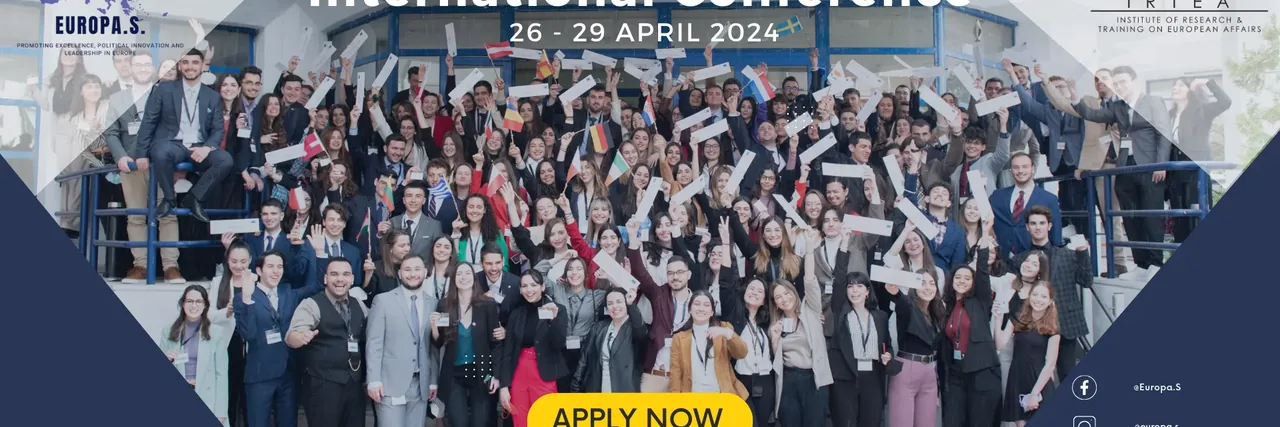
EUropa.S. Conference is the biggest simulation of the European Institutions in Greece and the Balkans organized by the Institute of Research & Training on European Affairs - I.R.T.E.A. Established back in 2010, it simulates the function of the main Institutions of the European Union: the European Parliament, the European Council, the European Commission, the European Court of Justice and the European Central Bank.

Our mission is to:

  1. Provide specialized training regarding the Institutions and Bodies of the European Union 
  2. Contribute to the better understanding of the EU’s structure, policies and procedures
  3. Stimulate the interest of young Europeans in EU related affairs
  4. Act as a forum of productive dialogue in the future of EU

Our vision is to narrow the gap between the academic knowledge and professional practice in EU related affairs, as well as to empower the European youth, by providing transferable life and work skills. Thus, EUropa.S. aims to promote the dissemination of knowledge and provide a first hand experience on EU institutions.

Committees

  • 27 countries
    1. Enlargement Policy of the European Union: The question of Western Balkans (Albania, Bosnia & Herzegovina, Kosovo)
    • Evangelia Papachristou

    European Council

    English · 27 countries

    Topic

    Enlargement Policy of the European Union: The question of Western Balkans (Albania, Bosnia & Herzegovina, Kosovo)

    About the committee

    The European Council (EC) is the intergovernmental body of European Union, which defines the general political direction and priorities of the European Union as a whole. The most important decisions on policy making level are made within the framework of the EC. The European Council is comprised of the 27 Heads of Nations and Governments of the European Union’s Member States as well as the President of the Council and the President of the Commission. Since the EC is the Union’s strategic body, the debate revolves around crucial issues that concern European Union’s present or future policies and actions. Since all EU member-states have a political system of Parliamentary Democracy, the Heads of States belong to political parties as well. Even though the Prime Ministers and Presidents have the Union’s and their respective states’ interests in mind, they must also keep the policy of the national parties they lead in mind. Given the European Union’s democratic character and emphasis on representation according the distribution of population, not all EC members have the same amount of votes at their disposal. The necessity to form alliances and coalitions, as well as the amount of votes each member of the Council has, is what makes this particular body even more intriguing and exciting.

    Chair

    Countries

    How this committee type works
  • 33 countries
    1. Violation of Data Protection legal framework: The issues of ambiguity in the GDPR Regulation

    European Court of Justice

    English · 33 countries

    Topic

    Violation of Data Protection legal framework: The issues of ambiguity in the GDPR Regulation

    About the committee

    The European Court of Justice ensures the uniform interpretation and application of EU law in all member countries. It also settles legal disputes between the governments of the member states and EU institutions. Individuals, companies and organizations may refer a case to the Court if they consider that their rights have not been upheld by an EU institution Each EU member State, indicates a representative judge to the Court. In order to function in the most accurate way, 9 general advocates, express their legal opinion concerning all the cases in the Court’s docket. They are obliged to do so, in public and in total impartiality and independence. Both of their terms in office are 6 years long and can be reviewed. It is easily understood that the Court’s docket is exceedingly large. Therefore, in 1988 the General Court was created, in order to secure every European citizen’s rights to judicial protection and fair trial. The General Court deals with cases submitted by individuals, companies and some organizations, and cases related to European competition law. The European Court of Justice deals with the following cases: Requests for preliminary rulings – when national courts address the Court to interpret a point of EU legislation Infringement actions – when national governments fail to apply European law. due to non-application of EU law Actions that indicate failure by EU institutions that do not take the necessary decisions Direct actions by individuals, companies or organizations in decisions or actions of the EU

    Countries

    How this committee type works
  • 20 countries
    1. Addressing the role of the EU as a Security Provider in times of instability and conflict

    • Athanasia Mouriki

    European Parliament - Security & Defence (SEDE)

    English · 20 countries

    Topic

    Addressing the role of the EU as a Security Provider in times of instability and conflict

    About the committee

    Against a background of geostrategic turbulence – emerging military powers, an ongoing terrorist threat, armed conflicts in the EU’s immediate neighborhood, the rise of hybrid warfare and cyber-attacks against EU strategic infrastructure – security and defence have risen to the top of the EU’s political agenda. The remit of the Subcommittee on Security and Defence is to provide a forum for thorough public debate on, and detailed parliamentary scrutiny of, all EU action in the area of the CSDP, whether it concerns institutions, capabilities or operations. SEDE intends to make an active contribution to the formulation of EU security and defence policy. Central to SEDE’s future activities will be the work of building closer relations with strategic partners, including NATO and the UN, and with third countries which are advocates of multilateralism and an international order that promotes peace. The SEDE Subcommittee is an interesting choice for participants willing to challenge themselves, dealing with the complex issues of the Union’s Security & Defense. The big challenge of this committee is to manage to agree on a certain common policy, given the fact that each member state, and of course each Political Group of the EP, has its own opinion over the EU’s competency to handle foreign policy and security issues. The big challenge of this committee is to manage to agree on a certain common policy, given the fact that each member state has its own opinion over the EU’s competency to handle foreign policy issues.

    Chair

    Countries

  • 21 countries
    1. Post-Covid : Leçons apprises, bilan et préparation pour l’inconnu

    • Effrosyni Drissi Boura

    European Parliament - Public Health (SANT)

    English · 21 countries

    Topic

    Post-Covid : Leçons apprises, bilan et préparation pour l’inconnu

    About the committee

    On 14 February 2023, the European Parliament approved the creation of the public health subcommittee, made up of 30 full members and 30 substitute members. According to its approved mandate, the subcommittee deals with pharmaceutical and cosmetic products, the health aspects of bioterrorism, the European Medicines Agency, and the European Centre for Disease Prevention and Control. In Europa.S., SANT Subcommittee of the European Parliament, which is going to be simulated in French, aims at bringing crucial issues to the table which must be addressed with caution. The MEPs will have the chance to adopt a new pharmaceutical strategy for Europe, which is considered one of the greatest challenges for the upcoming months. All lights are on them, as such framework should guarantee equal and permanent access to medicines, a critical element for citizens’ health in the European Union.

    Chair

    Countries

  • 26 countries
    1. Climate Change & Protecting EU waters: Addressing the issues of scarcity & water pollution

    • Dimitra Kornezou

    European Parliament - Environment, Public Health and Food Safety (ENVI)

    English · 26 countries

    Topic

    Climate Change & Protecting EU waters: Addressing the issues of scarcity & water pollution

    About the committee

    With 88 Members, ENVI is today the largest Sub-committee in the European Parliament. This fact could be considered as a strong symbol and a clear signal underlining the need for the EU to move forward faster and with more ambition to fight against climate change. During this mandate, the committee works towards generating the legislative framework to achieve carbon neutrality in Europe by 2050. It fights with decisiveness in order for the ambitious Green deal to be proposed to all European citizens, and eventually achieve the much-needed transition to a greener economy. The Committee fights to ensure a fair and just transition, to the benefit of all citizens. The ENVI Committee also works on other policy priorities: biodiversity, the circular economy, public health, food safety, air and water quality, the use of chemicals and pesticides, etc. In this context, it’s becoming clear that participants taking part in this subcommittee, must be both flexible and skilled to respond effectively on the issues included in the agenda. The ENVI Committee is an excellent choice for participants that would like to grab the chance to face some of the most important issues of the Union today, by looking in the future.

    Chair

    Countries

  • 23 countries
    1. SMART Cities & Digital Transition: Opportunities for Regional Development for a sustainable and efficient Europe

    European Parliament - Regional Development (REGI)

    English · 23 countries

    Topic

    SMART Cities & Digital Transition: Opportunities for Regional Development for a sustainable and efficient Europe

    About the committee

    The REGI Subcommittee of the European Parliament, is responsible for the economic, social, and territorial cohesion of the Union as well as the policies and the funds linked to it. This is considered one of the fundamental policies for regions, cities, public authorities, and all citizens. Cohesion has become the first pillar of the European “green new deal” with more than 100 billion Euros which will be invested in the energy transition and the fight against climate change, and the introduction of the transversal principle of respecting the climate. In this context, the REGI Subcommittee remains committed to this major policy which is a policy of solidarity of the Union, giving the least developed regions and states more funds to catch up and level out development inequalities and fairly adapt to new standards. Within its mission is also to ensure that European policies consider the priorities set out in Articles 174 and 349 of the Treaties, and the specificities of certain territories, in particular the Outermost Regions which have a particular status in the European Union, but also islands, mountainous, sparsely populated, cross-border regions, rural areas or in industrial transition. On this basis, participants willing to join this specific committee, should be openminded and insightful in order to stand up to the complex circumstances, driven by the rapidly changing rhythms of reality.

    Countries

  • 20 countries
    1. The Future of the Eurozone: Stabilizing the Volatile Price Fluctuation and Transitioning towards a Digital Euro
    • Alexandros Georgios Papadatis

    European Central Bank

    English · 20 countries

    Topic

    The Future of the Eurozone: Stabilizing the Volatile Price Fluctuation and Transitioning towards a Digital Euro

    About the committee

    The European Central Bank (ECB) is the prime component of the Eurosystem and the European System of Central Banks (ESCB) as well as one of seven institutions of the European Union. It is one of the world’s most important central banks established by the treaty of Amsterdam in May 1999, with the purpose of guaranteeing and maintaining price stability. On 1st December 2009, the Treaty of Lisbon became effective and the bank gained the official status of an EU institution. Today, it remains committed in ensuring price stability and the safety and soundness of the European banking system. The Governing Council, the simulated committee in Europa. S, holds as its main responsibility to adopt the guidelines and take the decisions necessary to ensure the performance of the tasks entrusted to the ECB and the Eurosystem, as well as formulate monetary policy for the euro area. It meets twice a month at the ECB’s premises in Frankfurt au Main, in Germany, accessing economic and monetary developments and taking monetary policy decisions. ECB’s unique structure, as well as its great variety of topics extended on monetary, economic, and banking affairs makes it an exciting choice for participants seeking to combine both excitement and academic quality while participating in such a demanding and fascinating committee.

    Chair

    Countries

  • 4 countries
    1. Topics as Set in the Parliamentary Committees

    European Commission

    English · 4 countries

    Topic

    Topics as Set in the Parliamentary Committees

    About the committee

    The European Commission is the EU’s politically independent executive arm. It is the only institution responsible for drawing up proposals for new European legislation that would be adopted by the Parliament or the Council of the EU. Moreover, it manages EU policies and allocates EU funding by setting EU spending priorities, it enforces the European Law along with the European Court of Justice (ECJ), ensures that the EU law is properly applied in all member states and represents the EU internationally. The European Commission operates as a cabinet government, composed by 27 members, one member per each member state and they are informally known as “Commissioners”. The candidate President of the Commission is proposed to the European Parliament assembly by the European Council. EC decides by a qualified majority and takes into account the elections of the European Parliament. The President of the European Commission is then elected by the European Parliament by a majority. Following this election, the President selects the 26 other members of the Commission, on the basis of the suggestions made by the Member States. The final list of Commissioners has to be agreed between the President and the European Council. The European Commission as a whole needs the Parliament’s consent. The Commissioners are bound by their oath at the ECJ, pledging to respect the treaties and to be completely independent in carrying out their duties during their mandate. The College of Commissioners, includes the President of the Commission, his seven Vice-Presidents, including the First Vice-President, and the High-Representative of the Union for Foreign Affairs and Security Policy and 20 Commissioners in charge of portfolios. The European Commission in EUropa.S. The European Commission in EUropa.S. consists of four (4) Commissioners and the President of the Commission. They shall act as an “informal” College of Commissioners, discussing upon the agenda set in the Parliamentary Committees simulated. Thus, Commissioners’ portfolios for EUropa.S. shall be appointed in a way that matches the topics to be discussed by the Parliamentary Committees. Within the Conference, the European Commission will act as a normal committee with every-day sessions. Commissioners will be allowed to enter and address the EP Committees with the status of an observer, when permission is given and under the schedule of the Conference.

    Countries

  • The main goal of the Press Team is to rush to capture the palm of negotiations and policy-shaping taken place both in and out of sessions, during the days of the conference. Interviews, Video Capture and the Twitter Account of Europa.S. will broadcast the official news account during the days of the conference. There videos, interviews and breaking news regarding crises will be uploaded. As the proceedings of EUropa.S.’s Institutions move forward and the political dialogue and debate negotiations between the participants intensify, the main goal of the Press Team is to pay attention and broadcast to the rest of the conference the news, the developments as well as the obstacles in each and every Institution’s processes.
    Press Team

    English

    About the committee

    The main goal of the Press Team is to rush to capture the palm of negotiations and policy-shaping taken place both in and out of sessions, during the days of the conference. Interviews, Video Capture and the Twitter Account of Europa.S. will broadcast the official news account during the days of the conference. There videos, interviews and breaking news regarding crises will be uploaded. As the proceedings of EUropa.S.’s Institutions move forward and the political dialogue and debate negotiations between the participants intensify, the main goal of the Press Team is to pay attention and broadcast to the rest of the conference the news, the developments as well as the obstacles in each and every Institution’s processes.
    Countries

    How this committee type works
  • Shadow Participants

    English

    Countries

Organizers

Efthimis Kounalakis
Vice President of the European Parliament
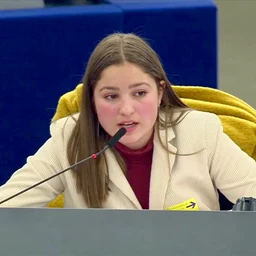
Michaela Fournarakou
President of the European Parliament

Veroniki Koutouzi Sinou
President of the European Commission

More MUN conferences

ConferencesGreeceEUropa.S. 2024